Report di esempio completo
Questo report proviene da una prova di allenamento di Task 1 al computer svolta da un candidato reale. Il tempo di scrittura, le pause, il numero di modifiche e il tempo fuori dalla pagina sono la registrazione originale del candidato. Per proteggerne la privacy, il saggio è stato riscritto a partire dall'originale con lo stesso livello e gli stessi tipi di errori. Punteggi, feedback, analisi del processo e modello sono stati tutti generati dal nostro sistema per questo saggio, proprio come li vedresti dopo aver scritto il tuo.
Provalo: clicca su un punto della linea temporale, su un link «Replay» in una scheda di prove, oppure avvia semplicemente il replay della scrittura qui sotto.
5.5
Punteggio (band) complessivo
A 0.5 dal band 6
Cosa hai fatto bene
- Una panoramica riconoscibile viene offerta presto ('Overall, the process has seven steps...'), ed è ciò che distingue un 6 da un 5 che è solo un resoconto.
- La sequenza delle fasi è segnalata chiaramente, così il lettore attraversa il processo senza confusione.
- Le etichette specifiche del tema dal diagramma — 'rain-shadow desert', 'windward side', 'leeward side', 'inland' — sono usate accuratamente.
Passi verso il band 6
- 1Usa forme corrette: 'blown' (non 'blowed'), 'carrying' (non 'carring'), 'the air keeps rising' (non 'is keep rising').
- 2Correggi la concordanza soggetto-verbo: 'clouds goes' → 'clouds go'; 'the high mountains blocks' → 'the mountains block'; 'the wind ... have arrived' → 'has arrived'.
- 3Correggi la posizione delle precipitazioni: la pioggia cade sul versante sopravvento vicino alla vetta, prima che l'aria attraversi la montagna, non dopo che le nuvole 'go over the top'.
Il mio elaborato163 parole · 9 frasi
Traccia
The diagram below shows how one type of desert, known as a rain-shadow desert, is formed. Summarise the information by selecting and reporting the main features, and make comparisons where relevant. Write at least 150 words.
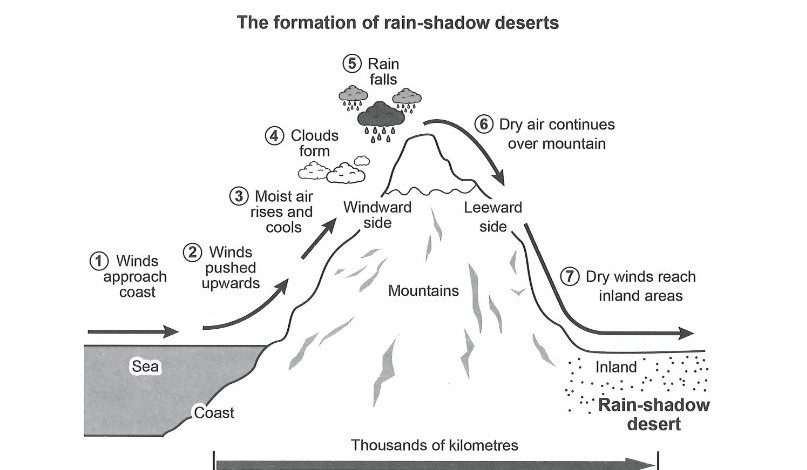
Il lessico è limitato e in gran parte tratto dalle etichette del diagramma (versante sopravvento, versante sottovento, deserto di ombra pluviometrica, entroterra), con poca parafrasi. Ci sono evidenti errori di formazione delle parole e di ortografia ('blowed' due volte, 'carring'), e gli stessi elementi ('wind', 'moist air', 'inland area') sono ripetuti. L'ampiezza è minimamente adeguata al compito e gli errori raramente ostacolano la comprensione.
Perché non Band 6
Band 6 richiede un'ampiezza adeguata di lessico con qualche tentativo di usare elementi meno comuni solo con occasionali imprecisioni. Qui l'ampiezza è ristretta e errori come 'blowed' e 'carring' sono ripetuti anziché occasionali, il che corrisponde alla descrizione della Band 5 di un'ampiezza limitata con evidenti errori di formazione delle parole.
Punti di forza
- Le etichette specifiche del tema dal diagramma — 'rain-shadow desert', 'windward side', 'leeward side', 'inland' — sono usate accuratamente.
- Compare un po' di lessico utile per i processi: 'moist air', 'becomes cold', 'clouds', 'slope', 'dry air'.
- Il significato è chiaro ovunque nonostante gli errori, quindi la comunicazione non è seriamente compromessa.
Da migliorare
- Usa forme corrette: 'blown' (non 'blowed'), 'carrying' (non 'carring'), 'the air keeps rising' (non 'is keep rising').
- Parafrasa di più invece di ripetere 'wind', 'moist air' e 'inland area' — ad es. 'air mass', 'the moisture-laden air', 'the interior'.
- Aggiungi collocazioni adatte a descrivere processi: 'the air is forced upwards', 'condenses to form clouds', 'releases its moisture as rain', 'descends the leeward slope'.
Più dettagli
Ampiezza del lessico: Quasi tutte le parole di contenuto provengono dal diagramma o dal linguaggio generale dei processi: 'ocean', 'windward side', 'moist air', 'clouds', 'leeward side', 'inland area'. C'è poca evidenza di risorse lessicali indipendenti come 'condense', 'precipitation', 'descend' o 'moisture-laden'.
Formazione delle parole e ortografia: 'the wind blowed from the ocean' e 'is blowed towards the windward side' usano il participio passato sbagliato; 'By carring very little water down the slope' scrive male 'carrying'. Sono errori evidenti del tipo descritto alla Band 5, anche se il lettore può ancora seguire.
Collocazioni: Frasi come 'starts dropping heavy rain' e 'clouds are appeared' sono goffe: la pioggia cade o viene rilasciata, e le nuvole si formano o compaiono. 'the moist air goes up and becomes cold' è accettabile ma potrebbe essere reso più preciso con 'rises, cools and condenses'.
Ripetizione: 'wind' compare cinque volte, 'moist air' tre volte e 'inland area' due volte, con 'keep' usato tre volte come verbo di continuazione. Questa ripetizione segnala una risorsa limitata.
Valutazione complessiva
Punti di forza riconosciuti:
Il saggio svolge il compito essenziale di una descrizione di processo: introduce chiaramente il diagramma, enuncia una panoramica e percorre le fasi dal mare al deserto dell'entroterra nell'ordine corretto. Il lessico specifico del tema tratto dal diagramma (versante sopravvento, versante sottovento, deserto di ombra pluviometrica, entroterra) è usato correttamente, la paragrafazione segue la logica del processo, e il lettore può seguire l'intera sequenza senza difficoltà.
Consigli strategici:
- Breve termine: impara un piccolo insieme di collocazioni accurate per i processi (the air is forced upwards, the air cools and condenses, clouds form, rain falls on the windward slope, the air descends and warms, the interior stays dry) e usale invece di formulazioni improvvisate.
- Medio termine: costruisci accuratezza con le forme verbali — participi passati (blow–blew–blown), terza persona -s, e quando il passivo è e non è possibile — riscrivendo le tue frasi dopo ogni attività di pratica.
- Lungo termine: esercitati a scrivere descrizioni di processi in cui spieghi causa ed effetto con parole tue anziché narrare le fasi una per una, così la panoramica e la catena causale sostengono la descrizione.
Azioni pratiche:
- Riscrivi questo saggio con la pioggia collocata sul versante sopravvento vicino alla vetta, e aggiungi una frase che spieghi che l'aria è secca nell'entroterra perché ha perso la sua umidità.
- Prendi dieci frasi dal tuo saggio e correggile, poi produci una versione pulita, concentrandoti solo sulla concordanza soggetto-verbo e sui participi passati.
- Fai altre tre attività con diagrammi di processo (ad es. il ciclo dell'acqua, la formazione di una cascata) e per ciascuna scrivi una panoramica di due frasi prima di descrivere le fasi.
- Crea una pagina di lessico con 15 verbi e collocazioni per processi (condense, evaporate, release moisture, descend, accumulate) e usane almeno otto nel prossimo Task 1.
Percorso di miglioramento:
Per raggiungere complessivamente la Band 6, Task Achievement e Coherence devono restare a 6 mentre Lexical Resource e Grammar salgono da 5 a 6. In pratica ciò significa scrivere con meno errori, non con più: elimina gli errori ripetuti come 'blowed', 'clouds are appeared' e 'mountains blocks', usa un insieme leggermente più ampio di verbi di processo e connettivi, e assicurati che la spiegazione causale sia fattualmente corretta. Se la descrizione è accurata e le frasi sono in gran parte prive di errori, la stessa struttura otterrebbe 6.5.
Come hai scritto questo elaborato
Si basa su come hai digitato nel simulatore d'esame: quando hai iniziato, dove ti sei fermato, cosa hai riscritto e come hai usato il tempo.
Sintesi dell'insegnante
La tua principale perdita è derivata dall'assenza di un controllo finale e da una pianificazione debole: hai digitato fino alla fine e hai ripetuto errori verbali che l'esaminatore ha segnalato.
Esercitati su questo nel prossimo elaborato: Esercitati a scrivere una forma verbale corretta in ogni frase e poi a controllarla una volta.
Cosa hai fatto bene
Sei arrivato a 163 parole entro il limite di tempo e hai seguito le fasi del diagramma in ordine.
Cronologia della scrittura
- Tempo totale
- 19:26
- Pianificazione
- 0:05
- Revisione
- 0:00
- Lontano dalla pagina
- 1:12
- Incollato
- 0%
4 abitudini che hanno influito sul voto
- Grammatical Range and Accuracy
Nessun controllo finale della grammatica
- Cosa è successo
- Hai digitato fino a 0:00 prima di inviare, e il 39% del saggio è arrivato negli ultimi 5 minuti. L'esaminatore ha comunque segnalato 10 errori, tra cui "blowed" e "clouds are appeared".
- Perché costa punti
- Piccoli errori verbali e di ortografia sono rimasti nel testo, il che è coerente con il 5 in GRA e LR.
La prossima volta: Al minuto 17, smetti di scrivere e dedica 3 minuti a controllare ogni desinenza verbale e l'ortografia.
Prove
- Task Achievement
Pianifica la panoramica prima di digitare
- Cosa è successo
- Hai iniziato a 0:05, poi hai fatto tre pause di 30-38 secondi durante la panoramica. Hai anche corretto quella frase 14 volte.
- Perché costa punti
- La panoramica è rimasta vaga: "which means the desert is mainly caused by the wind". Questo probabilmente ha indebolito TA e CC, entrambi 6.
La prossima volta: Prima di digitare, dedica 3 minuti a numerare le sette fasi e scrivi la panoramica in una sola frase su vento, montagne e pioggia.
Prove
- Grammatical Range and Accuracy
Correggi un verbo per frase
- Cosa è successo
- Ti sei fermato per 42 secondi su "Then, clouds goes over the top and starts dropping heavy rain." e hai corretto questa frase 9 volte. Hai corretto "clouds are appeared" 12 volte e "By carring..." 8 volte, ma gli errori sono rimasti.
- Perché costa punti
- L'esaminatore ha segnalato queste stesse forme, quindi questa correzione ripetuta non ha protetto GRA o LR.
La prossima volta: Dopo ogni frase, rileggila una volta e correggi il verbo: "clouds form", "the air keeps rising", "the desert is formed".
Prove
- Coherence and Cohesion
Lascia tempo per il paragrafo finale
- Cosa è successo
- Gli ultimi 5 minuti hanno contenuto 63 parole, e il paragrafo finale ha richiesto 4:58. Sei stato lontano dalla pagina per 1:12. Il finale aveva ancora "After raining on the top, but...".
- Perché costa punti
- Una chiusura affrettata con un collegamento rotto e una causa poco chiara può abbassare CC e TA.
La prossima volta: Inizia il paragrafo finale entro il minuto 15 e scrivi una frase chiara sulla causa: "The mountains take the rain, so the inland area stays dry."
Prove
Dove ti sei fermato più a lungo
- 42 sA metà frase · 12:51Then, clouds goes over the top and starts dropping heavy rain.
- 38 sA metà frase · 2:34Overall, the process has seven steps in which the wind blowed from the ocean travels a long way to the inland area, which means the desert is mainly caused by the wind.
- 30 sA metà frase · 1:42Overall, the process has seven steps in which the wind blowed from the ocean travels a long way to the inland area, which means the desert is mainly caused by the wind.
- 30 sA metà frase · 7:19Overall, the process has seven steps in which the wind blowed from the ocean travels a long way to the inland area, which means the desert is mainly caused by the wind.
- 23 sA metà frase · 0:20The diagram illustrates how a special kind of desert, called a rain-shadow desert, is formed.
Parole su cui hai esitato
Parole che hai cancellato e riscritto, o in cui ti sei fermato a metà. Quelle in rosso erano ancora segnate come errori.
Frasi che hai riscritto
- modificata 14 volteOverall, the process has seven steps in which the wind blowed from the ocean travels a long way to the inland area, which means the desert is mainly caused by the wind.
- modificata 12 volteWhen the moist air is cold enough, clouds are appeared.
- modificata 9 volteThen, clouds goes over the top and starts dropping heavy rain.
- modificata 8 volteBy carring very little water down the slope, the wind which is mostly dry air have arrived at the inland area.
- modificata 7 volteAfter raining on the top, but the air still keeps moving down along the leeward side.
Replay della scrittura
19:26 / 19:26 · 163 paroleIl tuo elaborato a Band 6.5
Stesse idee e stessa struttura, riscritte una banda più in alto, così vedi esattamente com'è il livello successivo.
Espressioni nuove o modificate
Il tuo testo
The diagram illustrates how a special kind of desert, called a rain-shadow desert, is formed.
Overall, the process has seven steps in which the wind blowed from the ocean travels a long way to the inland area, which means the desert is mainly caused by the wind.
At first, the wind from the ocean is blowed towards the windward side of the mountain. The air is keep rising and pushed higher, and then the moist air goes up and becomes cold. When the moist air is cold enough, clouds are appeared. Then, clouds goes over the top and starts dropping heavy rain.
After raining on the top, but the air still keeps moving down along the leeward side. By carring very little water down the slope, the wind which is mostly dry air have arrived at the inland area. That is how the rain-shadow desert keep forming and why almost no rain comes to the inland since the high mountains blocks the clouds.
Versione Band 6.5
The diagram illustrates how a special kind of desert, called a rain-shadow desert, is formed.
Overall, the process has seven steps, in which the wind from the ocean travels thousands of kilometres from the sea and coast to the inland area, so the desert is mainly caused by the wind.
At first, the wind from the ocean blows towards the windward side of the mountain. The air is forced upwards and keeps rising, and the moisture-laden air becomes cold as it goes up. When it is cold enough, clouds form. At this point, rain falls near the summit on the windward slope.
Subsequently, the air continues over the mountain top and descends the leeward side. Carrying very little water down the slope, the dry winds arrive at the inland area. Finally, the rain-shadow desert forms there. That is why almost no rain comes to the interior: the air has already released its moisture on the windward side, rather than being blocked by the mountains.
Cosa è cambiato
- Task Achievement
Ho corretto la posizione delle precipitazioni, cambiando 'Then, clouds goes over the top and starts dropping heavy rain' in 'At this point, rain falls near the summit on the windward slope', così ora la pioggia avviene chiaramente prima che l'aria attraversi la montagna.
- Task Achievement
Ho sostituito la causa imprecisa della secchezza in 'why almost no rain comes to the inland since the high mountains blocks the clouds' con 'the air has already released its moisture on the windward side, rather than being blocked by the mountains'. Ho anche aggiunto la scala e le etichette del diagramma: 'thousands of kilometres from the sea and coast to the inland area' e 'descends the leeward side'.
- Coherence and Cohesion
Ho dato alla panoramica un paragrafo a sé dopo l'introduzione, e ho sostituito il collegamento errato in 'After raining on the top, but the air still keeps moving down along the leeward side' con 'Subsequently, the air continues over the mountain top and descends the leeward side', aggiungendo 'At first' e 'Finally' per ampliare la gamma di connettivi.
- Grammatical Range and Accuracy
Ho corretto le forme verbali e la concordanza: 'the wind blowed' è diventato 'the wind ... blows', 'clouds are appeared' è diventato 'clouds form', 'the wind which is mostly dry air have arrived' è diventato 'the dry winds arrive', e 'the rain-shadow desert keep forming' è diventato 'the rain-shadow desert forms'.
- Lexical Resource
Ho corretto ortografia e forme delle parole ('blowed' in 'blows', 'carring' in 'Carrying') e ho usato più collocazioni di processo invece di ripetere la stessa formulazione: 'The air is forced upwards and keeps rising', 'the moisture-laden air becomes cold' e 'released its moisture'.
Dopo più esercizio: funzioni del passIllustrativo
Qui sopra c'è il vero report di un elaborato. Le tre sezioni sotto usano dati illustrativi per mostrare cosa aggiunge un pass quando lo stesso candidato scrive qualche elaborato in più e rivede questo.
Previsione per il giorno dell'esame
In base ai tuoi ultimi 3 elaborati, il tuo band in Writing il giorno dell'esame sarà probabilmente 5.0–5.5.
- Task Achievement5.5 ti mancano 1.0Caratteristiche o dati chiave, in 2 elaborati su 3
- Task Response6.0 ti mancano 0.5
- Coherence & Cohesion6.0 ti mancano 0.5Connettivi, in 2 elaborati su 3
- Lexical ResourceDivario maggiore5.0 ti mancano 1.5Ortografia, in 2 elaborati su 3
- Grammar5.0 ti mancano 1.5Accordo soggetto-verbo, in 3 elaborati su 3
La tua revisione ha portato Grammar da 5.0 a 6.0
Hai corretto 7 note su 11. Band complessivo 5.5 → 6.0.
- Complessivo5.5 → 6.0+0.5
- Task Achievement6.0 → 6.0Nessun cambiamento
- Coherence & Cohesion6.0 → 6.0Nessun cambiamento
- Lexical Resource5.0 → 5.0Nessun cambiamento
- Grammar5.0 → 6.0+1.0
The diagram illustrates how a special kind of desert, called a rain-shadow desert, is formed.
The diagram illustrates how a special kind of desert, called a rain-shadow desert, is formed.
Overall, the process has seven steps in which the wind blowed from the ocean travels a long way to the inland area, which means the desert is mainly caused by the wind.
Overall, the process has seven steps in which the wind that blows from the ocean travels a long way to the inland area, which means the desert is mainly caused by the wind.
At first, the wind from the ocean is blowed towards the windward side of the mountain. The air is keep rising and pushed higher, and then the moist air goes up and becomes cold. When the moist air is cold enough, clouds are appeared. Then, clouds goes over the top and starts dropping heavy rain.
At first, the wind from the ocean is blown towards the windward side of the mountain. The air keeps rising and is pushed higher, and then the moist air goes up and becomes cold. When the moist air is cold enough, clouds form. Then, clouds goes over the top and starts dropping heavy rain.
After raining on the top, but the air still keeps moving down along the leeward side. By carring very little water down the slope, the wind which is mostly dry air have arrived at the inland area. That is how the rain-shadow desert keep forming and why almost no rain comes to the inland since the high mountains blocks the clouds.
After raining on the top, but the air still keeps moving down along the leeward side. Carrying very little water down the slope, the wind, which is now mostly dry air, has arrived at the inland area. That is how the rain-shadow desert is formed and why almost no rain comes to the inland since the high mountains blocks the clouds.
4 note sono ancora aperte. Correggile, poi rivedi e rivaluta da «Prossimo passo» qui sotto, oppure scrivi un nuovo elaborato per mettere alla prova il cambiamento sotto pressione di tempo.
I miei errori
- Hai scrittothe rain-shadow desert keep formingMeglio cosìthe rain-shadow desert is formedElaborato 3
- Hai scrittothe wind which is mostly dry air have arrived at the inland areaMeglio cosìthe wind, which is now mostly dry air, has arrived at the inland areaElaborato 3
- Hai scrittoThen, clouds goes over the top and starts dropping heavy rain.Meglio cosìRain then falls on the windward slope near the summit.Elaborato 3