Kompletny przykładowy raport
Ten raport pochodzi z prawdziwego testu próbnego Task 1 w wersji komputerowej. Czas pisania, pauzy, liczba poprawek i czas poza stroną to oryginalny zapis kandydata. Aby chronić jego prywatność, esej został przepisany na podstawie oryginału na tym samym poziomie i z tymi samymi rodzajami błędów. Oceny, informacje zwrotne, analizę procesu i wzorcową odpowiedź wygenerował nasz system dla tego eseju – dokładnie tak, jak zobaczysz po napisaniu własnego.
Wypróbuj: kliknij kropkę na osi czasu, link „Odtwórz” na karcie z dowodem albo po prostu włącz odtwarzanie pisania poniżej.
5.5
Ogólny wynik band
Brakuje 0.5 do Band 6
Co Ci wyszło
- Ogólny przegląd pojawia się wcześnie ('Overall, the process has seven steps...'), a właśnie to odróżnia 6 od 5, w którym jest tylko odtworzenie danych.
- Kolejność etapów jest wyraźnie zaznaczona, więc czytelnik przechodzi przez proces bez zagubienia.
- Etykiety tematyczne z diagramu — 'rain-shadow desert', 'windward side', 'leeward side', 'inland' — są użyte poprawnie.
Kroki do Band 6
- 1Używaj poprawnych form: 'blown' (nie 'blowed'), 'carrying' (nie 'carring'), 'the air keeps rising' (nie 'is keep rising').
- 2Popraw zgodność podmiotu z orzeczeniem: 'clouds goes' → 'clouds go'; 'the high mountains blocks' → 'the mountains block'; 'the wind ... have arrived' → 'has arrived'.
- 3Popraw miejsce opadów: deszcz pada na nawietrznym stoku blisko szczytu, zanim powietrze przejdzie przez górę, a nie dopiero wtedy, gdy chmury 'go over the top'.
Mój esej163 słowa · 9 zdań
Pytanie
The diagram below shows how one type of desert, known as a rain-shadow desert, is formed. Summarise the information by selecting and reporting the main features, and make comparisons where relevant. Write at least 150 words.
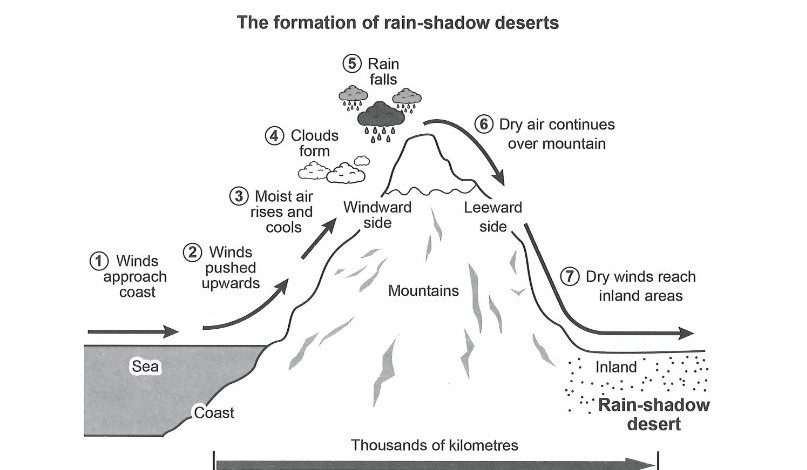
Słownictwo jest ograniczone i w dużej mierze zaczerpnięte z etykiet na diagramie (windward side, leeward side, rain-shadow desert, inland), z niewielką liczbą parafraz. Występują zauważalne błędy słowotwórcze i ortograficzne ('blowed' dwa razy, 'carring'), a te same elementy ('wind', 'moist air', 'inland area') się powtarzają. Zakres jest minimalnie wystarczający do zadania, a błędy rzadko utrudniają zrozumienie.
Dlaczego nie Band 6
Band 6 wymaga wystarczającego zakresu słownictwa z próbami użycia rzadszych elementów, z jedynie sporadycznymi nieścisłościami. Tutaj zakres jest wąski, a błędy takie jak 'blowed' i 'carring' są powtarzane, a nie sporadyczne, co odpowiada opisowi Band 5: ograniczony zakres z zauważalnymi błędami słowotwórczymi.
Mocne strony
- Etykiety tematyczne z diagramu — 'rain-shadow desert', 'windward side', 'leeward side', 'inland' — są użyte poprawnie.
- Pojawia się trochę przydatnego słownictwa opisującego proces: 'moist air', 'becomes cold', 'clouds', 'slope', 'dry air'.
- Mimo błędów znaczenie jest jasne w całym tekście, więc komunikacja nie jest poważnie zakłócona.
Do poprawy
- Używaj poprawnych form: 'blown' (nie 'blowed'), 'carrying' (nie 'carring'), 'the air keeps rising' (nie 'is keep rising').
- Częściej parafrazuj zamiast powtarzać 'wind', 'moist air' i 'inland area' — np. 'air mass', 'the moisture-laden air', 'the interior'.
- Dodaj kolokacje odpowiednie do opisu procesów: 'the air is forced upwards', 'condenses to form clouds', 'releases its moisture as rain', 'descends the leeward slope'.
Więcej szczegółów
Zakres słownictwa: Prawie wszystkie wyrazy znaczeniowe pochodzą z diagramu lub z ogólnego języka opisu procesów: 'ocean', 'windward side', 'moist air', 'clouds', 'leeward side', 'inland area'. Jest niewiele śladów samodzielnego zasobu leksykalnego, takiego jak 'condense', 'precipitation', 'descend' czy 'moisture-laden'.
Słowotwórstwo i pisownia: 'the wind blowed from the ocean' i 'is blowed towards the windward side' używają błędnej formy imiesłowu; 'By carring very little water down the slope' błędnie zapisuje 'carrying'. To zauważalne błędy typowe dla Band 5, choć czytelnik nadal może nadążyć.
Kolokacje: Wyrażenia takie jak 'starts dropping heavy rain' i 'clouds are appeared' są niezgrabne: deszcz pada lub jest uwalniany, a chmury powstają lub się pojawiają. 'the moist air goes up and becomes cold' jest dopuszczalne, ale można to wyostrzyć do 'rises, cools and condenses'.
Powtórzenia: 'wind' występuje pięć razy, 'moist air' trzy razy, a 'inland area' dwa razy, przy czym 'keep' jest użyte trzy razy jako czasownik ciągłości. Te powtórzenia świadczą o ograniczonym zasobie.
Pełna ocena
Mocne strony:
Esej wykonuje podstawowe zadanie opisu procesu: jasno przedstawia diagram, podaje ogólny przegląd i przechodzi przez etapy od morza do pustyni w głębi lądu w prawidłowej kolejności. Słownictwo tematyczne z diagramu (windward side, leeward side, rain-shadow desert, inland) jest użyte poprawnie, podział na akapity podąża za logiką procesu, a czytelnik bez trudu śledzi całą sekwencję.
Rada strategiczna:
- Krótkoterminowo: naucz się niewielkiego zestawu poprawnych kolokacji opisujących proces (the air is forced upwards, the air cools and condenses, clouds form, rain falls on the windward slope, the air descends and warms, the interior stays dry) i używaj ich zamiast improwizowanych sformułowań.
- Średnioterminowo: buduj poprawność form czasowników — imiesłowy (blow–blew–blown), końcówkę -s w 3. osobie liczby pojedynczej oraz to, kiedy strona bierna jest, a kiedy nie jest możliwa — przepisując własne zdania po każdym zadaniu.
- Długoterminowo: ćwicz pisanie opisów procesów, w których wyjaśniasz przyczynę i skutek własnymi słowami, zamiast opowiadać etapy jeden po drugim, tak aby opis niosły ogólny przegląd i łańcuch przyczynowy.
Konkretne kroki:
- Przepisz ten esej, umieszczając deszcz na nawietrznym stoku blisko szczytu, i dodaj jedno zdanie wyjaśniające, że w głębi lądu powietrze jest suche, bo straciło wilgoć.
- Weź z eseju dziesięć zdań i popraw je, a potem przygotuj czystą wersję, skupiając się wyłącznie na zgodności podmiotu z orzeczeniem i imiesłowach.
- Zrób jeszcze trzy zadania z diagramem procesu (np. the water cycle, the formation of a waterfall) i do każdego napisz dwuzdaniowy ogólny przegląd, zanim zaczniesz opisywać etapy.
- Stwórz stronę słownictwa z 15 czasownikami i kolokacjami opisującymi procesy (condense, evaporate, release moisture, descend, accumulate) i użyj co najmniej ośmiu z nich w następnym Task 1.
Ścieżka do wyższego wyniku:
Aby osiągnąć ogólnie Band 6, Task Achievement i Coherence muszą się utrzymać na 6, a Lexical Resource i Grammar wzrosnąć z 5 do 6. W praktyce oznacza to pisanie z mniejszą, a nie większą liczbą błędów: wyeliminuj powtarzające się pomyłki, takie jak 'blowed', 'clouds are appeared' i 'mountains blocks', użyj nieco szerszego zestawu czasowników procesu i łączników oraz upewnij się, że wyjaśnienie przyczynowe jest zgodne z faktami. Jeśli opis jest dokładny, a zdania w większości bezbłędne, ta sama struktura dałaby 6.5.
Jak pisałeś ten esej
Na podstawie tego, jak pisałeś w symulatorze egzaminu: kiedy zacząłeś, gdzie robiłeś pauzy, co przepisywałeś i jak wykorzystałeś czas.
Podsumowanie nauczyciela
Główna strata wzięła się z braku końcowego sprawdzenia i słabego planowania: tekst powstawał do samego końca, a błędy w czasownikach zaznaczone przez egzaminatora się powtarzały.
Przećwicz to w kolejnym eseju: Ćwicz pisanie jednej poprawnej formy czasownika w każdym zdaniu, a potem sprawdzanie jej jeden raz.
Co Ci wyszło dobrze
Do końca czasu tekst osiągnął 163 słowa, a etapy z diagramu zostały opisane po kolei.
Oś czasu pisania
- Łączny czas
- 19:26
- Planowanie
- 0:05
- Sprawdzanie
- 0:00
- Poza stroną
- 1:12
- Wklejono
- 0%
4 nawyki, które wpłynęły na Twój wynik
- Grammatical Range and Accuracy
Brak końcowego sprawdzenia gramatyki
- Co się stało
- Pisanie trwało do 0:00 przed wysłaniem, a 39% eseju powstało w ostatnich 5 minutach. Egzaminator mimo to zaznaczył 10 błędów, w tym "blowed" i "clouds are appeared".
- Dlaczego to kosztuje punkty
- Drobne błędy w czasownikach i pisowni zostały w tekście, co pasuje do 5 za GRA i LR.
Następnym razem: W 17. minucie przestań pisać i przeznacz 3 minuty na sprawdzenie każdej końcówki czasownika i pisowni.
Dowody
- Task Achievement
Zaplanuj ogólny przegląd przed pisaniem
- Co się stało
- Pisanie ruszyło o 0:05, a potem w trakcie ogólnego przeglądu pojawiły się trzy pauzy po 30-38 sekund. To zdanie było też poprawiane 14 razy.
- Dlaczego to kosztuje punkty
- Ogólny przegląd pozostał mglisty: "which means the desert is mainly caused by the wind". Prawdopodobnie osłabiło to TA i CC, oba na 6.
Następnym razem: Zanim zaczniesz pisać, poświęć 3 minuty na ponumerowanie siedmiu etapów i napisz ogólny przegląd w jednym zdaniu o wietrze, górach i deszczu.
Dowody
- Grammatical Range and Accuracy
Poprawiaj jeden czasownik w każdym zdaniu
- Co się stało
- Przy "Then, clouds goes over the top and starts dropping heavy rain." była pauza 42 sekundy, a to zdanie poprawiano 9 razy. "clouds are appeared" poprawiano 12 razy, a "By carring..." 8 razy, ale błędy zostały.
- Dlaczego to kosztuje punkty
- Egzaminator zaznaczył te same formy, więc to wielokrotne poprawianie nie ochroniło GRA ani LR.
Następnym razem: Po każdym zdaniu przeczytaj je raz i popraw czasownik: "clouds form", "the air keeps rising", "the desert is formed".
Dowody
- Coherence and Cohesion
Zostaw czas na ostatni akapit
- Co się stało
- W ostatnich 5 minutach powstało 63 słów, a ostatni akapit zajął 4:58. Przez 1:12 nie było Cię na stronie. Zakończenie nadal zawierało "After raining on the top, but...".
- Dlaczego to kosztuje punkty
- Pospieszne zakończenie z błędnym połączeniem i niejasną przyczyną może obniżyć CC i TA.
Następnym razem: Zacznij ostatni akapit do 15. minuty i napisz jedno jasne zdanie o przyczynie: "The mountains take the rain, so the inland area stays dry."
Dowody
Gdzie robiłeś najdłuższe pauzy
- 42 sW środku zdania · 12:51Then, clouds goes over the top and starts dropping heavy rain.
- 38 sW środku zdania · 2:34Overall, the process has seven steps in which the wind blowed from the ocean travels a long way to the inland area, which means the desert is mainly caused by the wind.
- 30 sW środku zdania · 1:42Overall, the process has seven steps in which the wind blowed from the ocean travels a long way to the inland area, which means the desert is mainly caused by the wind.
- 30 sW środku zdania · 7:19Overall, the process has seven steps in which the wind blowed from the ocean travels a long way to the inland area, which means the desert is mainly caused by the wind.
- 23 sW środku zdania · 0:20The diagram illustrates how a special kind of desert, called a rain-shadow desert, is formed.
Słowa, przy których się wahałeś
Słowa, które usuwałeś i pisałeś od nowa albo przy których robiłeś pauzę w środku. Czerwone nadal zostały oznaczone jako błędy.
Zdania, które przepisywałeś
- edytowano 14 razyOverall, the process has seven steps in which the wind blowed from the ocean travels a long way to the inland area, which means the desert is mainly caused by the wind.
- edytowano 12 razyWhen the moist air is cold enough, clouds are appeared.
- edytowano 9 razyThen, clouds goes over the top and starts dropping heavy rain.
- edytowano 8 razyBy carring very little water down the slope, the wind which is mostly dry air have arrived at the inland area.
- edytowano 7 razyAfter raining on the top, but the air still keeps moving down along the leeward side.
Odtwarzanie pisania
19:26 / 19:26 · 163 słowaTwój esej na poziomie Band 6.5
Te same pomysły i struktura, przepisane o jeden band wyżej, żeby dokładnie pokazać, jak wygląda następny poziom.
Nowe lub zmienione sformułowania
Twój esej
The diagram illustrates how a special kind of desert, called a rain-shadow desert, is formed.
Overall, the process has seven steps in which the wind blowed from the ocean travels a long way to the inland area, which means the desert is mainly caused by the wind.
At first, the wind from the ocean is blowed towards the windward side of the mountain. The air is keep rising and pushed higher, and then the moist air goes up and becomes cold. When the moist air is cold enough, clouds are appeared. Then, clouds goes over the top and starts dropping heavy rain.
After raining on the top, but the air still keeps moving down along the leeward side. By carring very little water down the slope, the wind which is mostly dry air have arrived at the inland area. That is how the rain-shadow desert keep forming and why almost no rain comes to the inland since the high mountains blocks the clouds.
Wersja Band 6.5
The diagram illustrates how a special kind of desert, called a rain-shadow desert, is formed.
Overall, the process has seven steps, in which the wind from the ocean travels thousands of kilometres from the sea and coast to the inland area, so the desert is mainly caused by the wind.
At first, the wind from the ocean blows towards the windward side of the mountain. The air is forced upwards and keeps rising, and the moisture-laden air becomes cold as it goes up. When it is cold enough, clouds form. At this point, rain falls near the summit on the windward slope.
Subsequently, the air continues over the mountain top and descends the leeward side. Carrying very little water down the slope, the dry winds arrive at the inland area. Finally, the rain-shadow desert forms there. That is why almost no rain comes to the interior: the air has already released its moisture on the windward side, rather than being blocked by the mountains.
Co się zmieniło
- Task Achievement
Poprawiłem miejsce opadów, zmieniając 'Then, clouds goes over the top and starts dropping heavy rain' na 'At this point, rain falls near the summit on the windward slope', dzięki czemu deszcz wyraźnie pada, zanim powietrze przejdzie przez górę.
- Task Achievement
Zastąpiłem błędną przyczynę suchości w 'why almost no rain comes to the inland since the high mountains blocks the clouds' zdaniem 'the air has already released its moisture on the windward side, rather than being blocked by the mountains'. Dodałem też skalę i etykiety z diagramu: 'thousands of kilometres from the sea and coast to the inland area' oraz 'descends the leeward side'.
- Coherence and Cohesion
Dałem ogólnemu przeglądowi osobny akapit po wstępie, a błędne połączenie w 'After raining on the top, but the air still keeps moving down along the leeward side' zastąpiłem zdaniem 'Subsequently, the air continues over the mountain top and descends the leeward side', dodając 'At first' i 'Finally', aby poszerzyć zakres łączników.
- Grammatical Range and Accuracy
Poprawiłem formy czasowników i zgodność: 'the wind blowed' zmieniło się w 'the wind ... blows', 'clouds are appeared' w 'clouds form', 'the wind which is mostly dry air have arrived' w 'the dry winds arrive', a 'the rain-shadow desert keep forming' w 'the rain-shadow desert forms'.
- Lexical Resource
Poprawiłem pisownię i formy wyrazów ('blowed' na 'blows', 'carring' na 'Carrying') i użyłem więcej kolokacji opisujących proces zamiast powtarzanych sformułowań: 'The air is forced upwards and keeps rising', 'the moisture-laden air becomes cold' oraz 'released its moisture'.
Po dalszej praktyce: funkcje passuPrzykład
Powyżej jest prawdziwy raport dla jednego eseju. Trzy sekcje poniżej używają przykładowych danych, by pokazać, co dodaje pass, gdy ten sam kandydat napisze jeszcze kilka esejów i zrewiduje ten.
Prognoza na dzień egzaminu
Na podstawie Twoich ostatnich 3 esejów Twój band z Writing w dniu egzaminu to prawdopodobnie 5.0–5.5.
- Task Achievement5.5 brakuje 1.0Kluczowe cechy lub dane: w 2 z 3 esejów
- Task Response6.0 brakuje 0.5
- Coherence & Cohesion6.0 brakuje 0.5Łączniki: w 2 z 3 esejów
- Lexical ResourceNajwiększa luka5.0 brakuje 1.5Pisownia: w 2 z 3 esejów
- Grammar5.0 brakuje 1.5Zgodność podmiotu z orzeczeniem: w 3 z 3 esejów
Twoja rewizja podniosła Grammar z 5.0 do 6.0
Poprawiono 7 z 11 uwag. Ogólny band 5.5 → 6.0.
- Ogółem5.5 → 6.0+0.5
- Task Achievement6.0 → 6.0Bez zmian
- Coherence & Cohesion6.0 → 6.0Bez zmian
- Lexical Resource5.0 → 5.0Bez zmian
- Grammar5.0 → 6.0+1.0
The diagram illustrates how a special kind of desert, called a rain-shadow desert, is formed.
The diagram illustrates how a special kind of desert, called a rain-shadow desert, is formed.
Overall, the process has seven steps in which the wind blowed from the ocean travels a long way to the inland area, which means the desert is mainly caused by the wind.
Overall, the process has seven steps in which the wind that blows from the ocean travels a long way to the inland area, which means the desert is mainly caused by the wind.
At first, the wind from the ocean is blowed towards the windward side of the mountain. The air is keep rising and pushed higher, and then the moist air goes up and becomes cold. When the moist air is cold enough, clouds are appeared. Then, clouds goes over the top and starts dropping heavy rain.
At first, the wind from the ocean is blown towards the windward side of the mountain. The air keeps rising and is pushed higher, and then the moist air goes up and becomes cold. When the moist air is cold enough, clouds form. Then, clouds goes over the top and starts dropping heavy rain.
After raining on the top, but the air still keeps moving down along the leeward side. By carring very little water down the slope, the wind which is mostly dry air have arrived at the inland area. That is how the rain-shadow desert keep forming and why almost no rain comes to the inland since the high mountains blocks the clouds.
After raining on the top, but the air still keeps moving down along the leeward side. Carrying very little water down the slope, the wind, which is now mostly dry air, has arrived at the inland area. That is how the rain-shadow desert is formed and why almost no rain comes to the inland since the high mountains blocks the clouds.
4 uwagi wciąż są otwarte. Popraw je, potem zrewiduj tekst i oceń ponownie w sekcji „Następny krok” poniżej albo napisz nowy esej, by sprawdzić zmianę pod presją czasu.
Moje błędy
- Napisanothe rain-shadow desert keep formingLepiejthe rain-shadow desert is formedEsej 3
- Napisanothe wind which is mostly dry air have arrived at the inland areaLepiejthe wind, which is now mostly dry air, has arrived at the inland areaEsej 3
- NapisanoThen, clouds goes over the top and starts dropping heavy rain.LepiejRain then falls on the windward slope near the summit.Esej 3