Complete sample report
This report comes from a real candidate's Task 1 computer-delivered practice test. The writing time, pauses, edit counts and time away from the page are the candidate's original record. To protect their privacy, the essay has been rewritten from the original at the same level and with the same kinds of mistakes. The scores, feedback, process analysis and model answer were all generated by our system for this essay, just as you would see after writing your own.
Try it: click a dot on the timeline, a "Replay" link in an evidence card, or just play the writing replay below.
5.5
Overall Band Score
0.5 away from Band 6
What you did well
- A recognisable overview is offered early ('Overall, the process has seven steps...'), which is what distinguishes a 6 from a recount-only 5.
- The sequence of stages is signalled clearly, so the reader moves through the process without confusion.
- Topic-specific labels from the diagram — 'rain-shadow desert', 'windward side', 'leeward side', 'inland' — are used accurately.
Steps to Band 6
- 1Use correct forms: 'blown' (not 'blowed'), 'carrying' (not 'carring'), 'the air keeps rising' (not 'is keep rising').
- 2Fix subject-verb agreement: 'clouds goes' → 'clouds go'; 'the high mountains blocks' → 'the mountains block'; 'the wind ... have arrived' → 'has arrived'.
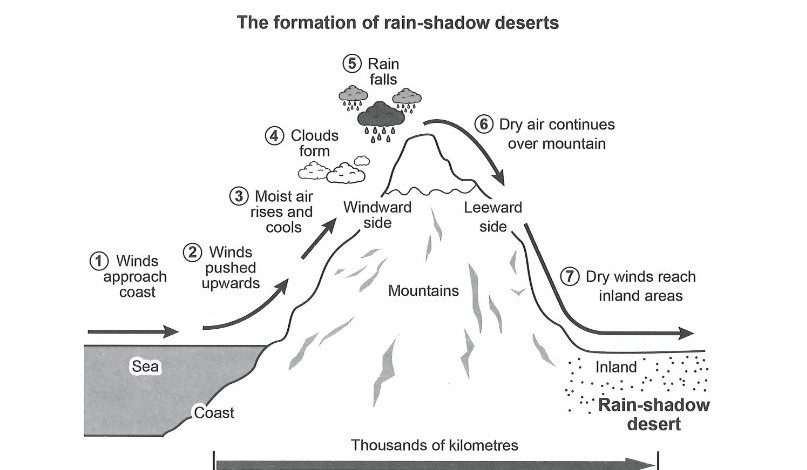
- 3Correct the position of rainfall: rain falls on the windward slope near the summit, before the air crosses the mountain, not after the clouds 'go over the top'.
My essay163 words · 9 sentences
Question
The diagram below shows how one type of desert, known as a rain-shadow desert, is formed. Summarise the information by selecting and reporting the main features, and make comparisons where relevant. Write at least 150 words.
Vocabulary is limited and largely drawn from the labels in the diagram (windward side, leeward side, rain-shadow desert, inland), with little paraphrase. There are noticeable word-formation and spelling errors ('blowed' twice, 'carring'), and the same items ('wind', 'moist air', 'inland area') are repeated. The range is minimally adequate for the task and the errors rarely block understanding.
Why not Band 6
Band 6 requires an adequate range of vocabulary with some attempt at less common items used with only occasional inaccuracy. Here the range is narrow and errors such as 'blowed' and 'carring' are repeated rather than occasional, matching the Band 5 description of a limited range with noticeable word-formation errors.
Strengths
- Topic-specific labels from the diagram — 'rain-shadow desert', 'windward side', 'leeward side', 'inland' — are used accurately.
- Some useful process vocabulary appears: 'moist air', 'becomes cold', 'clouds', 'slope', 'dry air'.
- Meaning is clear throughout despite the errors, so communication is not seriously damaged.
To improve
- Use correct forms: 'blown' (not 'blowed'), 'carrying' (not 'carring'), 'the air keeps rising' (not 'is keep rising').
- Paraphrase more instead of repeating 'wind', 'moist air' and 'inland area' — e.g. 'air mass', 'the moisture-laden air', 'the interior'.
- Add collocations suited to describing processes: 'the air is forced upwards', 'condenses to form clouds', 'releases its moisture as rain', 'descends the leeward slope'.
More detail
Vocabulary range: Almost all content words come from the diagram or from general process language: 'ocean', 'windward side', 'moist air', 'clouds', 'leeward side', 'inland area'. There is little evidence of independent lexical resource such as 'condense', 'precipitation', 'descend' or 'moisture-laden'.
Word formation and spelling: 'the wind blowed from the ocean' and 'is blowed towards the windward side' use the wrong past participle; 'By carring very little water down the slope' misspells 'carrying'. These are noticeable errors of the kind described at Band 5, though the reader can still follow.
Collocation: Phrases such as 'starts dropping heavy rain' and 'clouds are appeared' are awkward: rain falls or is released, and clouds form or appear. 'the moist air goes up and becomes cold' is acceptable but could be sharpened to 'rises, cools and condenses'.
Repetition: 'wind' appears five times, 'moist air' three times and 'inland area' twice, with 'keep' used three times as a verb of continuation. This repetition signals a limited resource.
Comprehensive Evaluation
Strengths Recognition:
The essay does the essential job of a process description: it introduces the diagram clearly, states an overview, and walks through the stages from the sea to the inland desert in the correct order. Topic vocabulary from the diagram (windward side, leeward side, rain-shadow desert, inland) is used correctly, paragraphing follows the logic of the process, and the reader can follow the whole sequence without difficulty.
Strategic Advice:
- Short term: learn a small set of accurate process collocations (the air is forced upwards, the air cools and condenses, clouds form, rain falls on the windward slope, the air descends and warms, the interior stays dry) and use them instead of improvised phrasing.
- Medium term: build accuracy with verb forms — past participles (blow–blew–blown), third-person -s, and when the passive is and is not possible — by rewriting your own sentences after each practice task.
- Long term: practise writing process descriptions where you explain cause and effect in your own words rather than narrating stages one by one, so the overview and the causal chain carry the description.
Practical Action Items:
- Rewrite this essay with the rain placed on the windward slope near the summit, and add one sentence explaining that the air is dry inland because it has lost its moisture.
- Take ten sentences from your essay and correct them, then produce a clean version, focusing only on subject-verb agreement and past participles.
- Do three more process-diagram tasks (e.g. the water cycle, the formation of a waterfall) and for each write a two-sentence overview before describing the stages.
- Build a vocabulary page of 15 process verbs and collocations (condense, evaporate, release moisture, descend, accumulate) and use at least eight of them in the next Task 1.
Score Progression Path:
To reach Band 6 overall, Task Achievement and Coherence must hold at 6 while Lexical Resource and Grammar rise from 5 to 6. In practice that means writing with fewer, not more, errors: eliminate repeated mistakes such as 'blowed', 'clouds are appeared' and 'mountains blocks', use a slightly wider set of process verbs and linkers, and make sure the causal explanation is factually right. If the description is accurate and the sentences are largely error-free, the same structure would score 6.5.
How you wrote this essay
Based on how you typed in the exam simulator: when you started, where you paused, what you rewrote and how you used the time.
Teacher's summary
Your main loss came from no final check and weak planning: you typed until the end and repeated verb errors that the examiner marked.
Practise this in your next essay: Practise writing one correct verb form in each sentence, then checking it once.
What you did well
You reached 163 words by the time limit and followed the diagram's stages in order.
Writing timeline
- Total time
- 19:26
- Planning
- 0:05
- Checking
- 0:00
- Away from page
- 1:12
- Pasted
- 0%
4 habits that affected your score
- Grammatical Range and Accuracy
No final check for grammar
- What happened
- You typed until 0:00 before submitting, and 39% of the essay came in the last 5 minutes. The examiner still marked 10 errors, including "blowed" and "clouds are appeared".
- Why it costs marks
- Small verb and spelling mistakes stayed in the text, which fits the 5 for GRA and LR.
Next time: At minute 17, stop writing and spend 3 minutes checking every verb ending and spelling.
Evidence
- Task Achievement
Plan the overview before typing
- What happened
- You began at 0:05, then spent three 30-38 second pauses inside the overview. You also corrected that sentence 14 times.
- Why it costs marks
- The overview stayed vague: "which means the desert is mainly caused by the wind". This probably weakened TA and CC, both 6.
Next time: Before typing, spend 3 minutes numbering the seven stages and write the overview in one sentence about wind, mountains and rain.
Evidence
- Grammatical Range and Accuracy
Fix one verb per sentence
- What happened
- You paused 42 seconds at "Then, clouds goes over the top and starts dropping heavy rain." and corrected this sentence 9 times. You corrected "clouds are appeared" 12 times and "By carring..." 8 times, but errors remained.
- Why it costs marks
- The examiner marked these same forms, so this repeated editing did not protect GRA or LR.
Next time: After each sentence, re-read it once and fix the verb: "clouds form", "the air keeps rising", "the desert is formed".
Evidence
- Coherence and Cohesion
Leave time for the final paragraph
- What happened
- The last 5 minutes held 63 words, and the final paragraph took 4:58. You were away from the page for 1:12. The ending still had "After raining on the top, but...".
- Why it costs marks
- A rushed close with a broken link and an unclear cause can lower CC and TA.
Next time: Start the final paragraph by minute 15 and write one clear cause sentence: "The mountains take the rain, so the inland area stays dry."
Evidence
Where you paused longest
- 42sMid-sentence · 12:51Then, clouds goes over the top and starts dropping heavy rain.
- 38sMid-sentence · 2:34Overall, the process has seven steps in which the wind blowed from the ocean travels a long way to the inland area, which means the desert is mainly caused by the wind.
- 30sMid-sentence · 1:42Overall, the process has seven steps in which the wind blowed from the ocean travels a long way to the inland area, which means the desert is mainly caused by the wind.
- 30sMid-sentence · 7:19Overall, the process has seven steps in which the wind blowed from the ocean travels a long way to the inland area, which means the desert is mainly caused by the wind.
- 23sMid-sentence · 0:20The diagram illustrates how a special kind of desert, called a rain-shadow desert, is formed.
Words you hesitated on
Words you deleted and retyped, or paused in the middle of. Red ones were still marked as errors.
Sentences you rewrote
- edited 14 timesOverall, the process has seven steps in which the wind blowed from the ocean travels a long way to the inland area, which means the desert is mainly caused by the wind.
- edited 12 timesWhen the moist air is cold enough, clouds are appeared.
- edited 9 timesThen, clouds goes over the top and starts dropping heavy rain.
- edited 8 timesBy carring very little water down the slope, the wind which is mostly dry air have arrived at the inland area.
- edited 7 timesAfter raining on the top, but the air still keeps moving down along the leeward side.
Writing replay
19:26 / 19:26 · 163 wordsYour essay at Band 6.5
Same ideas and structure, rewritten one band higher, so you can see exactly what the next level looks like.
New or changed wording
Your essay
The diagram illustrates how a special kind of desert, called a rain-shadow desert, is formed.
Overall, the process has seven steps in which the wind blowed from the ocean travels a long way to the inland area, which means the desert is mainly caused by the wind.
At first, the wind from the ocean is blowed towards the windward side of the mountain. The air is keep rising and pushed higher, and then the moist air goes up and becomes cold. When the moist air is cold enough, clouds are appeared. Then, clouds goes over the top and starts dropping heavy rain.
After raining on the top, but the air still keeps moving down along the leeward side. By carring very little water down the slope, the wind which is mostly dry air have arrived at the inland area. That is how the rain-shadow desert keep forming and why almost no rain comes to the inland since the high mountains blocks the clouds.
Band 6.5 version
The diagram illustrates how a special kind of desert, called a rain-shadow desert, is formed.
Overall, the process has seven steps, in which the wind from the ocean travels thousands of kilometres from the sea and coast to the inland area, so the desert is mainly caused by the wind.
At first, the wind from the ocean blows towards the windward side of the mountain. The air is forced upwards and keeps rising, and the moisture-laden air becomes cold as it goes up. When it is cold enough, clouds form. At this point, rain falls near the summit on the windward slope.
Subsequently, the air continues over the mountain top and descends the leeward side. Carrying very little water down the slope, the dry winds arrive at the inland area. Finally, the rain-shadow desert forms there. That is why almost no rain comes to the interior: the air has already released its moisture on the windward side, rather than being blocked by the mountains.
What changed
- Task Achievement
I corrected the position of the rainfall, changing 'Then, clouds goes over the top and starts dropping heavy rain' to 'At this point, rain falls near the summit on the windward slope', so the rain now clearly happens before the air crosses the mountain.
- Task Achievement
I replaced the inaccurate cause of the dryness in 'why almost no rain comes to the inland since the high mountains blocks the clouds' with 'the air has already released its moisture on the windward side, rather than being blocked by the mountains'. I also added the diagram's scale and labels: 'thousands of kilometres from the sea and coast to the inland area' and 'descends the leeward side'.
- Coherence and Cohesion
I gave the overview its own paragraph after the introduction, and I replaced the faulty link in 'After raining on the top, but the air still keeps moving down along the leeward side' with 'Subsequently, the air continues over the mountain top and descends the leeward side', adding 'At first' and 'Finally' to widen the range of linkers.
- Grammatical Range and Accuracy
I fixed the verb forms and agreement: 'the wind blowed' became 'the wind ... blows', 'clouds are appeared' became 'clouds form', 'the wind which is mostly dry air have arrived' became 'the dry winds arrive', and 'the rain-shadow desert keep forming' became 'the rain-shadow desert forms'.
- Lexical Resource
I corrected spelling and word forms ('blowed' to 'blows', 'carring' to 'Carrying') and used more process collocations instead of repeated wording: 'The air is forced upwards and keeps rising', 'the moisture-laden air becomes cold' and 'released its moisture'.
After more practice: pass featuresIllustrative
Above is the real report for one essay. The three sections below use illustrative data to show what a pass adds once the same candidate writes a few more essays and revises this one.
Exam-day forecast
Based on your last 3 essays, your Writing band on exam day is likely 5.0–5.5.
- Task Achievement5.5 1.0 to goKey features or data, in 2 of 3 essays
- Task Response6.0 0.5 to go
- Coherence & Cohesion6.0 0.5 to goLinking words, in 2 of 3 essays
- Lexical ResourceBiggest gap5.0 1.5 to goSpelling, in 2 of 3 essays
- Grammar5.0 1.5 to goSubject-verb agreement, in 3 of 3 essays
Your revision lifted Grammar from 5.0 to 6.0
You fixed 7 of 11 notes. Overall band 5.5 → 6.0.
- Overall5.5 → 6.0+0.5
- Task Achievement6.0 → 6.0No change
- Coherence & Cohesion6.0 → 6.0No change
- Lexical Resource5.0 → 5.0No change
- Grammar5.0 → 6.0+1.0
The diagram illustrates how a special kind of desert, called a rain-shadow desert, is formed.
The diagram illustrates how a special kind of desert, called a rain-shadow desert, is formed.
Overall, the process has seven steps in which the wind blowed from the ocean travels a long way to the inland area, which means the desert is mainly caused by the wind.
Overall, the process has seven steps in which the wind that blows from the ocean travels a long way to the inland area, which means the desert is mainly caused by the wind.
At first, the wind from the ocean is blowed towards the windward side of the mountain. The air is keep rising and pushed higher, and then the moist air goes up and becomes cold. When the moist air is cold enough, clouds are appeared. Then, clouds goes over the top and starts dropping heavy rain.
At first, the wind from the ocean is blown towards the windward side of the mountain. The air keeps rising and is pushed higher, and then the moist air goes up and becomes cold. When the moist air is cold enough, clouds form. Then, clouds goes over the top and starts dropping heavy rain.
After raining on the top, but the air still keeps moving down along the leeward side. By carring very little water down the slope, the wind which is mostly dry air have arrived at the inland area. That is how the rain-shadow desert keep forming and why almost no rain comes to the inland since the high mountains blocks the clouds.
After raining on the top, but the air still keeps moving down along the leeward side. Carrying very little water down the slope, the wind, which is now mostly dry air, has arrived at the inland area. That is how the rain-shadow desert is formed and why almost no rain comes to the inland since the high mountains blocks the clouds.
4 notes are still open. Fix them, then revise and rescore from Next step below, or write a new essay to test the change under time pressure.
My mistakes
- You wrotethe rain-shadow desert keep formingBetter asthe rain-shadow desert is formedEssay 3
- You wrotethe wind which is mostly dry air have arrived at the inland areaBetter asthe wind, which is now mostly dry air, has arrived at the inland areaEssay 3
- You wroteThen, clouds goes over the top and starts dropping heavy rain.Better asRain then falls on the windward slope near the summit.Essay 3