Cambridge IELTS 18 Test 3 Writing Task 1: Library Floor Plans
Cambridge IELTS 18 · Test 3 · Academic Writing Task 1Map / plan
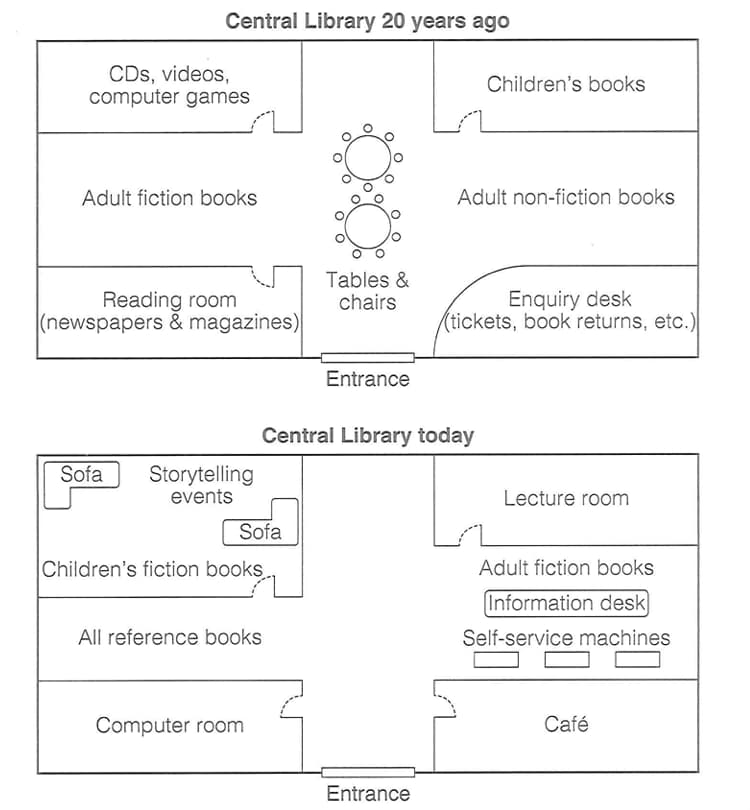
The two plans show the layout of the Central Library 20 years ago and its layout today. Both buildings have a single entrance at the front and a central corridor with rooms on either side, so the task is to compare how the use of each area has changed.
The question
You should spend about 20 minutes on this task. The diagram below shows the floor plan of a public library 20 years ago and how it looks now. Summarise the information by selecting and reporting the main features, and make comparisons where relevant. Write at least 150 words.
Free and timed, with a live word count, just like the computer-delivered test. Then get an instant AI band score.
The exam simulator runs on a computer. Open this page on a laptop or desktop to practise.
Key features to report
- The entrance and the basic shape of the building, with a central open area and three sections on each side, are unchanged; almost everything inside has been moved, replaced or removed.
- The two rooms beside the entrance have changed function: the reading room for newspapers and magazines on the left is now a computer room, and the enquiry desk for tickets and book returns on the right has become a café.
- The tables and chairs in the central area have been removed, leaving the middle of the library as open space.
- Adult fiction books have moved from the left side to the right side, where an information desk and self-service machines have been added. The adult non-fiction section no longer appears, and the left middle section now holds all reference books.
- At the back, the room for CDs, videos and computer games has been replaced by a larger children's fiction area with two sofas and storytelling events, and the old children's books room on the right is now a lecture room.
- Overall, the library has shifted from storing and lending books and media towards technology, self-service, events and social spaces.
Model overview
Overall, while the entrance and the basic layout of the building have stayed the same, the library has been transformed from a place mainly for lending books and media into a more modern space offering technology, events and refreshments. Most of the original rooms have been relocated or given new functions, and several features have disappeared completely.
Paragraph plan
- 1
Introduction
Paraphrase the task in one sentence: the two plans illustrate how the layout of the Central Library has changed over the past two decades.
- 2
Overview
Without details, state that the entrance and overall shape are unchanged, that the library has moved from lending books and media towards technology, events and social facilities, and that most rooms have been relocated or repurposed.
- 3
Body paragraph 1: the library 20 years ago
Describe the old layout from the entrance to the back: reading room on the left and enquiry desk on the right, adult fiction and adult non-fiction in the middle sections with tables and chairs between them, and the CDs, videos and computer games room opposite the children's books at the back.
- 4
Body paragraph 2: the library today
Explain the changes in the same order: computer room and café beside the entrance, tables and chairs removed, adult fiction moved to the right with an information desk and self-service machines, reference books on the left, a larger children's fiction area with sofas and storytelling events at the back left, and a lecture room in place of the old children's section.
Useful comparisons
- Describe the plans in the order a visitor would walk through the building, starting at the entrance and moving to the back.
- Pair each old room with what replaced it: reading room to computer room, enquiry desk to café, media room to children's fiction, children's books to lecture room.
- Group features that have disappeared: tables and chairs, CDs, videos and computer games, newspapers and magazines, and the enquiry desk.
- Group new features: computer room, café, lecture room, self-service machines, information desk, sofas and storytelling events.
- Note what moved rather than disappeared: adult fiction switched sides, and children's books moved from the back right to the back left.
- Comment on the general purpose of the changes, from quiet storage and borrowing towards technology, learning events and social space.
Band 8+ model answer
210 words · An original model answer written for ieltswrites, not an official answer. It stays in English, as in the exam.
The two plans illustrate how the layout of the Central Library has changed over the last two decades.
Overall, although the entrance and basic shape of the building are unchanged, the library has been transformed from a place mainly for borrowing books and media into a modern space offering technology, events and refreshments, with almost every room relocated or repurposed.
Twenty years ago, visitors found a reading room for newspapers and magazines on their left and an enquiry desk for tickets and book returns on their right. Beyond these, adult fiction and adult non-fiction books occupied the two middle sections, with tables and chairs in the open area between them. At the rear, a room for CDs, videos and computer games stood opposite the children's books.
Today, the reading room has become a computer room and the enquiry desk has made way for a café, while the central tables and chairs have gone. Adult fiction has moved to the right-hand side, where an information desk and self-service machines have been installed, and the left-hand section now houses all reference books. At the back, the media room has been replaced by a larger children's fiction area with sofas and storytelling events, and the former children's section has become a lecture room.
Why this answer scores highly
- Task Achievement
- The answer gives a clear overview of the shift from lending to technology, events and social space, and it covers all the main changes accurately without speculating about reasons.
- Coherence and Cohesion
- Both body paragraphs follow the same route from the entrance to the back of the building, so the reader can easily match each old room with its replacement, and location phrases act as clear signposts.
- Lexical Resource
- A wide range of change vocabulary, such as converted into, relocated, made way for and installed, is used accurately, together with precise location phrases like on the right-hand side and at the rear.
- Grammatical Range and Accuracy
- Present perfect passive forms describe the changes, past tenses describe the old layout, and relative clauses and participle phrases add detail without errors.
Useful vocabulary
- floor plan
- a drawing that shows the layout of rooms in a building from above
- layout
- the way the parts of a building are arranged
- be converted into
- be changed so that it is used for a different purpose
- be replaced by
- have something new put in its position
- be relocated
- be moved to a different place
- make way for
- be removed so that something new can take its place
- be installed
- be put in place and made ready for use, used for machines and equipment
- repurpose
- use a room or space for a new function
- self-service machines
- machines that let visitors borrow or return items without help from staff
- on the left-hand side
- in the part to the left, a useful way to give locations
- at the rear of the building
- at the back, furthest from the entrance
- remain intact
- stay unchanged and complete
- storytelling events
- sessions where stories are read or told aloud, usually for children
Common mistakes
- Using active verbs with no clear subject, such as the café built, instead of passive forms like a café has been built or the enquiry desk has been replaced by a café.
- Using the wrong tenses: the old plan should be described in the past and the changes in the present perfect.
- Listing the rooms in each plan separately without linking each old room to what replaced it.
- Inventing reasons for the changes, such as people no longer read newspapers, which is personal opinion and not shown in the plans.
- Saying that the non-fiction books were turned into reference books; the plans only show that adult non-fiction no longer appears and that reference books now occupy the left middle section.
- Forgetting to mention features that were removed, especially the tables and chairs in the centre.
Frequently asked questions
- Which Cambridge book is this question from?
- This question about the floor plan of a public library 20 years ago and today is Writing Task 1 of Test 3 in Cambridge IELTS 18 Academic, published in 2023.
- Which tenses should I use for a map or plan task like this?
- Use past simple for the layout 20 years ago, present simple for the current layout, and present perfect passive for the changes, for example the reading room has been converted into a computer room.
- Do I need to mention every room on the plans?
- You should cover the main changes, which here involve most rooms, but you do not need small details such as the number of sofas or self-service machines. Grouping related changes keeps the answer concise.
- How many words should I write for this Task 1?
- Write at least 150 words; around 170-210 words lets you describe both plans and the overview clearly in 20 minutes.
Free and timed, with a live word count, just like the computer-delivered test. Then get an instant AI band score.
The exam simulator runs on a computer. Open this page on a laptop or desktop to practise.