剑桥雅思16 Test 4 写作 Task 1:塑料瓶回收流程图
剑桥雅思 16 · Test 4 · 学术类写作 Task 1流程图
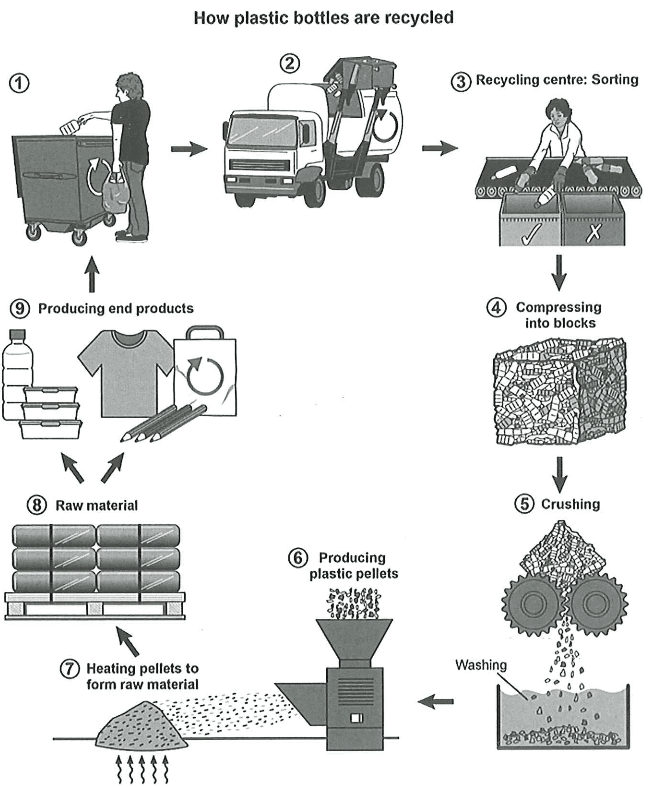
这幅示意图展示了塑料瓶如何经过九个带编号的阶段被回收,从放入回收箱、由卡车收运,到被加工成原材料并制成新产品。这一过程是一个循环,因为最终产品可以再次使用和回收。
题目
You should spend about 20 minutes on this task. The diagram below shows the process for recycling plastic bottles. Summarize the information by selecting and reporting the main features, and make comparisons where relevant. Write at least 150 words.
免费计时练习,实时显示字数,和机考一模一样。写完即可获得 AI 即时评分。
考试模拟器需在电脑上使用。请用笔记本或台式机打开本页进行练习。
需要写出的关键特征
- 共有九个阶段,且这一过程是循环的:从阶段9出发的箭头回到阶段1,所以新产品可以再次被回收。这一点应在概述中说明。
- 最初的阶段是收集:瓶子被放入回收箱(阶段1),并由收运卡车运走(阶段2)。
- 在回收中心,瓶子在传送带上经人工分拣,分为适用和不适用的物品(阶段3),然后被压缩成块(阶段4)。
- 这些块在辊子之间被压碎成小片,随后被清洗(阶段5),再由机器加工成塑料颗粒(阶段6)。
- 颗粒经加热形成原材料(阶段7),以卷的形式储存(阶段8),并用于制造瓶子、食品容器、T恤等服装、袋子和铅笔等最终产品(阶段9)。
- 这幅图可以分为三个阶段:收集和分拣、把塑料加工成颗粒和原材料,以及制造新产品。
概述范例
总体而言,塑料瓶的回收是一个包含九个阶段的循环过程,从收集用过的瓶子开始,到制造本身也可以被回收的新产品结束。这一过程包含三个主要阶段:收集和分拣、把塑料转化为原材料,以及生产新的商品。
段落规划
- 1
引言段
改写题目:这幅图说明了塑料瓶回收的各个阶段。
- 2
概述段
说明共有九个阶段,这一过程是一个循环,并且从收集和分拣推进到加工,最后到制造新产品。
- 3
主体段1:收集、分拣和压缩
描述瓶子被放入回收箱,由卡车收运,送到回收中心并在传送带上经人工分拣、剔除不适用的物品,然后被压缩成块。
- 4
主体段2:加工和新产品
说明这些块被压碎并清洗,变成塑料颗粒,经加热形成原材料,然后用来制造新瓶子、食品容器、T恤、袋子和铅笔等最终产品,这些产品可以重新进入循环。
可用的对比点
- 把阶段分为三个部分:收集和分拣(1-3)、加工(4-8)和制造(9)。
- 追踪塑料形态的变化:整瓶、压缩块、压碎的小片、颗粒、原材料,最后是新产品。
- 对比分拣阶段的人工操作与后续阶段使用的机器。
- 突出最终产品的多样性:不仅有新瓶子,还有食品容器、服装、袋子和铅笔。
- 强调循环的特点:阶段9制成的产品可以在阶段1再次被放入回收箱。
- 使用被动语态和多样的顺序词,如 initially、once sorted、following this、at this point 和 finally。
8 分以上范文
195 词 · 本范文为 ieltswrites 原创,并非官方答案。与考试一样,范文保持英文。
The diagram illustrates how plastic bottles are recycled and turned into new products.
Overall, the process is cyclical and consists of nine stages, beginning with the collection of used bottles and ending with the manufacture of new goods, which can themselves be recycled. The plastic is first collected and sorted, then processed into raw material, and finally used to make a variety of items.
Initially, used bottles are placed in a recycling bin, from which they are collected by a truck and transported to a recycling centre. Here, they are sorted by hand on a conveyor belt, and any unsuitable items are rejected. The remaining bottles are then compressed into large blocks.
Following this, the blocks are crushed between rollers into small fragments, which are washed before being fed into a machine that produces plastic pellets. These pellets are subsequently heated to form raw material, which is stored in rolls. At the final stage, this material is used to manufacture a range of end products, including new bottles, food containers, clothing, bags and pencils. Once these products have been used, they can be put into a recycling bin again, so the cycle begins once more.
这篇为什么能拿高分
- 任务完成度 (Task Achievement)
- 九个阶段都被准确且按顺序涵盖,提到了最终产品的多样性,概述指出了这一过程的循环性质及其主要阶段。
- 连贯与衔接 (Coherence and Cohesion)
- 各阶段被合理地分成两个主体段,多样的顺序手段以及 these blocks、the resulting pellets 等指代使步骤衔接流畅。
- 词汇资源 (Lexical Resource)
- 精准地使用了 compressed、crushed、pellets、raw material、conveyor belt 等过程词汇,并对图中的标签作了同义改写而不是照抄。
- 语法范围与准确性 (Grammatical Range and Accuracy)
- 始终准确地使用一般现在时被动语态,并配合关系从句、分词短语和时间状语从句增加句式的丰富度。
实用词汇
- recycling bin
- 回收箱:盛放将被回收的物品的容器
- collection truck
- 收运卡车:收集垃圾或回收物的车辆
- recycling centre
- 回收中心:对材料进行分拣和加工以便再利用的地方
- conveyor belt
- 传送带:在工厂里运送物品的移动带子
- sort
- 分拣:把物品分成几类,如适用和不适用的
- discard
- 丢弃:扔掉或剔除某物
- compress
- 压缩:挤压某物使其占用空间变小
- crush
- 压碎:通过挤压把某物弄成小块
- pellets
- 颗粒:材料的小而硬的碎粒
- raw material
- 原材料:用来制造产品的基本材料
- end products
- 最终产品:一个过程结束时制成的成品
- cyclical process
- 循环过程:回到起点并不断重复的过程
- re-enter the cycle
- 重新进入循环:重新开始这一过程
常见错误
- 没有提到这一过程是循环,而这是图中的主要特征。
- 跳过某些阶段,比如压碎后的清洗,或者顺序写错。
- 编造图中没有的细节,例如塑料在某个具体温度下熔化。
- 使用主语含糊的主动句,如 they put the bottles in a machine,而不是被动语态。
- 逐字照抄标签,如 Compressing into blocks,而不是将其改写为完整的句子。
- 概述像主体段一样冗长地罗列各个阶段,而不是概括主要的几个阶段。
常见问题
- 这道题出自剑桥雅思哪一册?
- 这幅塑料瓶回收过程的示意图,是2021年出版的《剑桥雅思16 学术类》Test 4 的写作 Task 1。
- 循环过程的概述应该怎么写?
- 说明共有几个阶段、过程从哪里开始到哪里结束,以及最终产品可以回到起点,然后不带细节地点出主要的阶段。
- 需要列出每一种最终产品吗?
- 不需要,但举出两三个例子(如新瓶子、服装和食品容器),就能说明这种原材料可用于制造多种商品。
- 要写多少词?
- 至少写150词;大约170-200词就足以清楚地描述全部九个阶段。
免费计时练习,实时显示字数,和机考一模一样。写完即可获得 AI 即时评分。
考试模拟器需在电脑上使用。请用笔记本或台式机打开本页进行练习。