Cambridge IELTS 16 Test 4 Writing Task 1: Recycling Bottles
Cambridge IELTS 16 · Test 4 · Academic Writing Task 1Process diagram
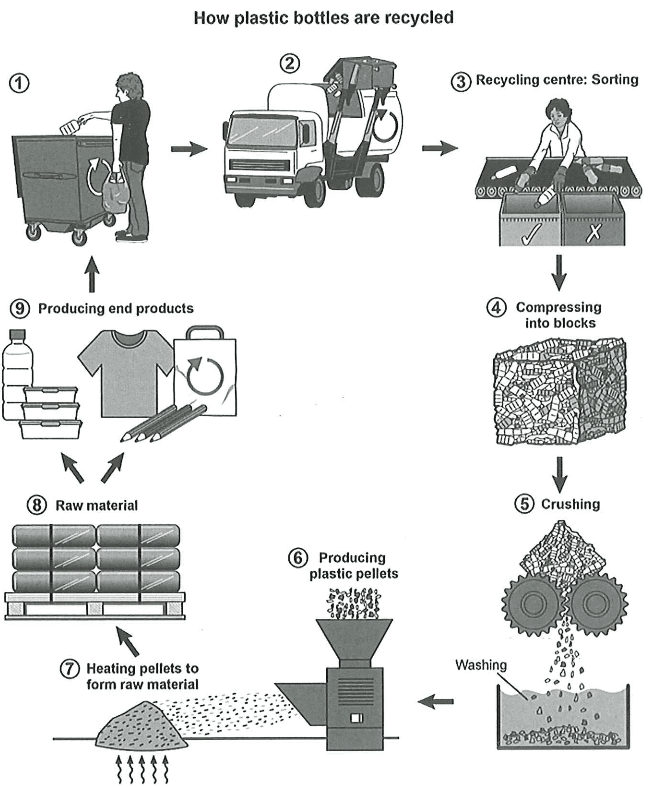
The diagram shows how plastic bottles are recycled in nine numbered stages, from being put into a recycling bin and collected by truck to being turned into raw material and made into new products. The process is a cycle, because the end products can be used and recycled again.
The question
You should spend about 20 minutes on this task. The diagram below shows the process for recycling plastic bottles. Summarize the information by selecting and reporting the main features, and make comparisons where relevant. Write at least 150 words.
Free and timed, with a live word count, just like the computer-delivered test. Then get an instant AI band score.
The exam simulator runs on a computer. Open this page on a laptop or desktop to practise.
Key features to report
- There are nine stages, and the process is cyclical: the arrow from stage 9 returns to stage 1, so the new products can be recycled again. This should be stated in the overview.
- The first stages are collection: bottles are placed in a recycling bin (stage 1) and taken away by a collection truck (stage 2).
- At the recycling centre the bottles are sorted by hand on a conveyor belt into suitable and unsuitable items (stage 3), then compressed into blocks (stage 4).
- The blocks are crushed between rollers into small pieces, which are then washed (stage 5), before being processed by a machine into plastic pellets (stage 6).
- The pellets are heated to form raw material (stage 7), which is stored in rolls (stage 8) and used to manufacture end products such as bottles, food containers, clothing like T-shirts, bags and pencils (stage 9).
- The diagram can be grouped into three phases: collection and sorting, processing the plastic into pellets and raw material, and manufacturing new products.
Model overview
Overall, plastic bottle recycling is a cyclical process of nine stages, starting with the collection of used bottles and ending with the manufacture of new products that can themselves be recycled. The process involves three main phases: collection and sorting, the conversion of the plastic into raw material, and the production of new goods.
Paragraph plan
- 1
Introduction
Paraphrase the task: the diagram illustrates the stages in the recycling of plastic bottles.
- 2
Overview
State that there are nine stages, that the process is a cycle, and that it moves from collection and sorting to processing and finally to making new products.
- 3
Body paragraph 1: collection, sorting and compressing
Describe bottles being placed in a recycling bin, collected by truck, taken to a recycling centre and sorted by hand on a conveyor belt, with unsuitable items removed, and then compressed into blocks.
- 4
Body paragraph 2: processing and new products
Explain that the blocks are crushed and washed, turned into plastic pellets, heated to form raw material, and then used to make end products such as new bottles, food containers, T-shirts, bags and pencils, which can re-enter the cycle.
Useful comparisons
- Group the stages into three phases: collection and sorting (1-3), processing (4-8) and manufacturing (9).
- Trace how the plastic changes form: whole bottles, compressed blocks, small crushed pieces, pellets, raw material and finally new products.
- Contrast manual work at the sorting stage with the machines used in later stages.
- Highlight the variety of end products: not only new bottles but also food containers, clothing, bags and pencils.
- Emphasise the cyclical nature: the products made in stage 9 can be placed in a recycling bin again at stage 1.
- Use the passive voice and a range of sequencers, such as initially, once sorted, following this, at this point and finally.
Band 8+ model answer
195 words · An original model answer written for ieltswrites, not an official answer. It stays in English, as in the exam.
The diagram illustrates how plastic bottles are recycled and turned into new products.
Overall, the process is cyclical and consists of nine stages, beginning with the collection of used bottles and ending with the manufacture of new goods, which can themselves be recycled. The plastic is first collected and sorted, then processed into raw material, and finally used to make a variety of items.
Initially, used bottles are placed in a recycling bin, from which they are collected by a truck and transported to a recycling centre. Here, they are sorted by hand on a conveyor belt, and any unsuitable items are rejected. The remaining bottles are then compressed into large blocks.
Following this, the blocks are crushed between rollers into small fragments, which are washed before being fed into a machine that produces plastic pellets. These pellets are subsequently heated to form raw material, which is stored in rolls. At the final stage, this material is used to manufacture a range of end products, including new bottles, food containers, clothing, bags and pencils. Once these products have been used, they can be put into a recycling bin again, so the cycle begins once more.
Why this answer scores highly
- Task Achievement
- All nine stages are covered accurately and in order, the variety of end products is mentioned, and the overview identifies the cyclical nature of the process and its main phases.
- Coherence and Cohesion
- The stages are divided logically into two body paragraphs, and varied sequencing devices and referencing such as these blocks and the resulting pellets link the steps smoothly.
- Lexical Resource
- Process vocabulary such as compressed, crushed, pellets, raw material and conveyor belt is used precisely, and the diagram labels are paraphrased rather than copied.
- Grammatical Range and Accuracy
- The present simple passive is used consistently and accurately, with relative clauses, participle phrases and time clauses adding range.
Useful vocabulary
- recycling bin
- a container for items that will be recycled
- collection truck
- a vehicle that collects waste or recycling
- recycling centre
- a place where materials are sorted and processed for reuse
- conveyor belt
- a moving belt that carries items through a factory
- sort
- separate items into groups, e.g. suitable and unsuitable
- discard
- throw away or reject something
- compress
- press something so that it takes up less space
- crush
- break something into small pieces by pressing it
- pellets
- small, hard pieces of a material
- raw material
- a basic material used to make products
- end products
- the finished goods made at the end of a process
- cyclical process
- a process that returns to its starting point and repeats
- re-enter the cycle
- start the process again
Common mistakes
- Failing to mention that the process is a cycle, which is the main feature of the diagram.
- Skipping stages, such as washing after crushing, or describing them in the wrong order.
- Inventing details not shown, for example how the plastic is melted at a specific temperature.
- Using active sentences with vague subjects, such as they put the bottles in a machine, instead of the passive voice.
- Copying the labels word for word, such as Compressing into blocks, rather than paraphrasing them into full sentences.
- Listing the stages in an overview that is as long as the body paragraphs instead of summarising the main phases.
Frequently asked questions
- Which Cambridge book is this question from?
- This diagram of how plastic bottles are recycled is Writing Task 1 of Test 4 in Cambridge IELTS 16 Academic, published in 2021.
- How do I write an overview for a cyclical process?
- Say how many stages there are, where the process starts and ends, and that the final products can return to the beginning, then name the main phases without details.
- Do I need to list every end product?
- No, but naming two or three examples, such as new bottles, clothing and food containers, shows that the raw material is used for a range of goods.
- How many words should I write?
- Write at least 150 words; about 170-200 words is enough to describe all nine stages clearly.
Free and timed, with a live word count, just like the computer-delivered test. Then get an instant AI band score.
The exam simulator runs on a computer. Open this page on a laptop or desktop to practise.