Cambridge IELTS 20 Test 4 Writing Task 1: Bamboo Fabric Process
Cambridge IELTS 20 · Test 4 · Academic Writing Task 1Process diagram
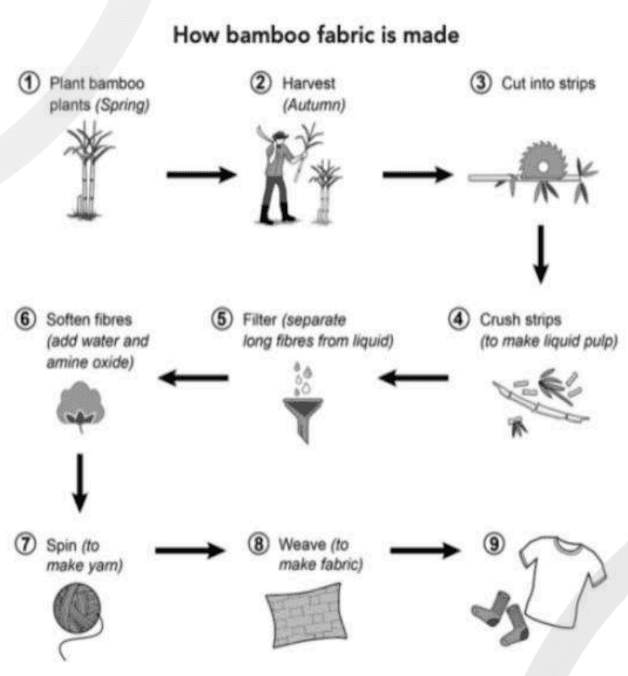
The diagram shows the process by which fabric is manufactured from bamboo. It consists of nine stages, from planting bamboo in spring and harvesting it in autumn to crushing, filtering and softening the fibres, spinning them into yarn, weaving the yarn into fabric and finally making clothing.
The question
You should spend about 20 minutes on this task. You should spend about 20 minutes on this task. Write at least 150 words. The diagram below shows how fabric is manufactured from bamboo. Summarise the information by selecting and reporting the main features, and make comparisons where relevant. Write at least 150 words.
Free and timed, with a live word count, just like the computer-delivered test. Then get an instant AI band score.
The exam simulator runs on a computer. Open this page on a laptop or desktop to practise.
Key features to report
- This is a linear, man-made process with nine stages: it starts with growing bamboo and ends with finished clothes, shown as a T-shirt and socks at stage 9.
- The process can be divided into two main phases: an agricultural phase (planting in spring and harvesting in autumn) and a manufacturing phase that turns the harvested stems into fabric.
- After harvesting, the bamboo is cut into strips, which are then crushed to make a liquid pulp.
- The pulp is filtered to separate the long fibres from the liquid, and these fibres are then softened by adding water and amine oxide, the only chemical named in the diagram.
- The softened fibres are spun to make yarn, the yarn is woven to make fabric, and the fabric is finally used to produce clothing.
- Because the diagram gives the purpose of several stages in brackets (to make liquid pulp, to make yarn, to make fabric), a strong answer includes these purposes rather than just listing the verbs.
Model overview
Overall, the production of bamboo fabric involves nine stages, beginning with the cultivation of bamboo and ending with the manufacture of clothing. The process can be divided into an agricultural phase, in which the plants are grown and harvested, and an industrial phase, in which the raw bamboo is turned into fibres, yarn and finally fabric.
Paragraph plan
- 1
Introduction
Paraphrase the task in one sentence: the diagram illustrates the stages involved in producing fabric from bamboo.
- 2
Overview
State that there are nine stages, from growing bamboo to making clothes, and that the process falls into an agricultural phase and a manufacturing phase. Do not describe individual steps in detail here.
- 3
Body paragraph 1: growing and preparing the bamboo
Describe planting in spring and harvesting in autumn, then cutting the stems into strips and crushing the strips to make a liquid pulp.
- 4
Body paragraph 2: from pulp to finished products
Explain how the pulp is filtered to separate the long fibres from the liquid, how the fibres are softened with water and amine oxide, then spun into yarn and woven into fabric, which is finally made into clothes such as T-shirts and socks.
Useful comparisons
- Split the process into two phases: growing the bamboo (stages 1-2) and processing it into fabric (stages 3-9).
- Alternatively, group the manufacturing stages by product: from stems to pulp (stages 3-4), from pulp to fibres (stages 5-6) and from fibres to fabric and clothes (stages 7-9).
- Mention the seasons for the first two stages, since they show that the cycle of planting and harvesting takes several months.
- Include the purpose of each stage where the diagram gives it, for example crushed to make a liquid pulp and spun to make yarn.
- Note that the liquid is separated from the long fibres at the filtering stage, so only the fibres continue to the next step.
- Use a range of sequencing devices, such as first, once, after that, at this point, subsequently and finally, rather than repeating then.
Band 8+ model answer
172 words · An original model answer written for ieltswrites, not an official answer. It stays in English, as in the exam.
The diagram illustrates the sequence of stages involved in producing fabric from bamboo, from growing the raw material to making finished clothes.
Overall, the process consists of nine stages, beginning with the cultivation of bamboo and ending with the manufacture of clothing. It can be divided into an agricultural phase, in which the plants are grown and harvested, and an industrial phase, in which the raw bamboo is gradually converted into fibres, yarn and finally fabric.
First, bamboo plants are planted in spring and left to grow until autumn, when they are harvested. The harvested stems are then cut into strips, and these strips are crushed in order to produce a liquid pulp.
At the next stage, the pulp is filtered so that the long fibres are separated from the liquid. The resulting fibres are softened by adding water and amine oxide, after which they are spun to make yarn. This yarn is subsequently woven into fabric, which, in the final stage, is used to make garments such as T-shirts and socks.
Why this answer scores highly
- Task Achievement
- The answer includes a clear overview of the nine stages and the two phases, and covers every step accurately, including the seasons, the purposes in brackets and the chemical added during softening.
- Coherence and Cohesion
- The stages are presented in logical order across two body paragraphs, and varied sequencing devices and referencing such as these strips and the resulting fibres connect each step to the next.
- Lexical Resource
- Process vocabulary such as cultivation, liquid pulp, spun into yarn and woven into fabric is used precisely, and the diagram's labels are paraphrased where possible rather than copied.
- Grammatical Range and Accuracy
- The answer uses the present simple passive consistently and accurately, combined with relative clauses, participle phrases and purpose structures such as in order to.
Useful vocabulary
- manufacture
- make goods in large quantities using machines
- cultivation
- the growing of plants or crops
- harvest
- cut and gather a crop when it is ready
- strips
- long, narrow pieces of a material
- crush
- press something hard so that it breaks into small pieces or becomes soft
- pulp
- a soft, wet mass made by crushing plant material
- filter
- pass a liquid through a device that removes solid parts
- fibres
- thin threads of natural material that can be made into yarn
- soften
- make something less hard or stiff
- spin into yarn
- twist fibres together to make a long thread
- weave into fabric
- cross threads over and under each other to make cloth
- garments
- items of clothing
- the final stage
- the last step in a process
- subsequently
- after that; a formal sequencing word
Common mistakes
- Using the active voice with invented subjects such as farmers or workers, instead of the passive voice that is normal for describing a manufacturing process.
- Leaving out the purposes shown in brackets, so the reader does not know why the strips are crushed or what spinning produces.
- Missing the seasons, spring for planting and autumn for harvesting, which are labelled in the diagram.
- Misdescribing stage 5, for example saying that the liquid is kept, when the filter separates the long fibres from the liquid and the fibres go on to the next stage.
- Giving no overview stating how many stages there are and where the process begins and ends.
- Adding information that is not in the diagram, such as claims that bamboo fabric is environmentally friendly or how long each stage takes.
Frequently asked questions
- Which Cambridge book is this question from?
- This process diagram showing how fabric is manufactured from bamboo is Writing Task 1 of Test 4 in Cambridge IELTS 20 Academic.
- Should I use the passive voice for this process?
- Yes. Because the diagram focuses on what happens to the bamboo rather than who does it, the present simple passive, such as the strips are crushed, is the most natural choice.
- What do I write for stage 9, which has no label?
- Stage 9 shows a T-shirt and socks, so describe it as the final stage, in which the fabric is used to make clothing or garments.
- How many words should I write for this Task 1?
- Write at least 150 words; around 170-200 words is enough to give an overview and describe all nine stages in about 20 minutes.
Free and timed, with a live word count, just like the computer-delivered test. Then get an instant AI band score.
The exam simulator runs on a computer. Open this page on a laptop or desktop to practise.