Cambridge IELTS 10 Test 4 Writing Task 1: Salmon Life Cycle
Cambridge IELTS 10 · Test 4 · Academic Writing Task 1Process diagram
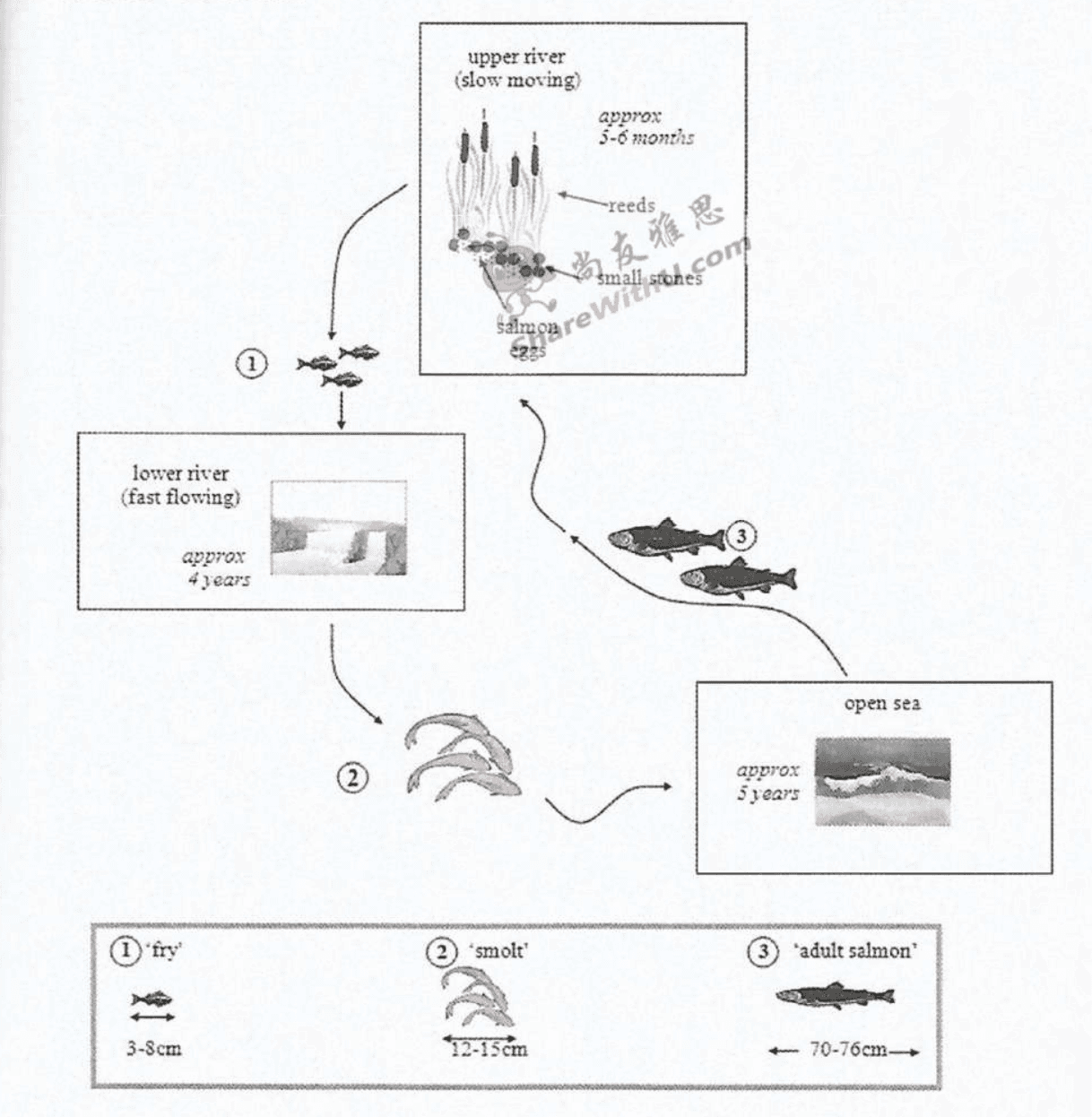
The diagram shows the life cycle of the salmon, a species of large fish, as a circular process with three habitats: the slow-moving upper river, the fast-flowing lower river and the open sea. It gives the approximate time spent in each place and the size of the fish at three stages: fry (3-8cm), smolt (12-15cm) and adult salmon (70-76cm).
The question
You should spend about 20 minutes on this task. The diagrams below show the life cycle of a speicies of large fish called the salmon. Summarise the information by selecting and reporting the main features, and make comparisons where relevant. Write at least 150 words.
Free and timed, with a live word count, just like the computer-delivered test. Then get an instant AI band score.
The exam simulator runs on a computer. Open this page on a laptop or desktop to practise.
Key features to report
- The process is a cycle: it begins with eggs in the upper river and ends when adult salmon swim back to the upper river, where the cycle starts again.
- The eggs are laid in the slow-moving upper river among reeds and small stones, and they stay there for approximately 5-6 months.
- The young fish, called fry, measure 3-8cm and move downstream to the fast-flowing lower river, where they spend approximately 4 years.
- After this, they become smolt, measuring 12-15cm, and migrate to the open sea, where they live for approximately 5 years.
- Adult salmon reach 70-76cm before returning upstream to the upper river.
- The fish grow from just a few centimetres to over 70cm, and the whole cycle takes roughly nine and a half years, most of it spent in the lower river and the sea.
Model overview
Overall, the salmon's life cycle has three main stages, fry, smolt and adult, which take place in three different habitats, from the upper river to the open sea and back again. During this period of almost a decade, the fish grow from a few centimetres to well over 70 centimetres in length.
Paragraph plan
- 1
Introduction
Paraphrase the task in one sentence: the diagram illustrates the stages in the life of the salmon, a large fish that lives in both rivers and the sea.
- 2
Overview
Say that the life cycle is circular, with three main stages in three habitats, and that the fish grow dramatically in size. Do not give the measurements here.
- 3
Body paragraph 1: eggs and fry
Describe the eggs laid among reeds and small stones in the slow-moving upper river, where they remain for about 5-6 months, then the fry (3-8cm) moving to the fast-flowing lower river for about 4 years.
- 4
Body paragraph 2: smolt and adults
Describe the smolt (12-15cm) migrating to the open sea for about 5 years, growing into adult salmon of 70-76cm, which then swim back to the upper river, where the cycle begins again.
Useful comparisons
- Organise the description by habitat: upper river, lower river, open sea, then the return journey.
- Contrast the two river habitats: slow-moving water in the upper river and fast-flowing water in the lower river.
- Compare the time spent in each place: about 5-6 months as eggs, about 4 years in the lower river and about 5 years at sea.
- Show the increase in size across the three named stages: 3-8cm, 12-15cm and 70-76cm.
- Emphasise that the process is circular by ending with the adults returning to where the eggs are laid.
- Use the passive for the eggs (are laid, are protected) and active verbs for the fish's movements (migrate, swim, return).
Band 8+ model answer
199 words · An original model answer written for ieltswrites, not an official answer. It stays in English, as in the exam.
The diagram illustrates the life cycle of the salmon, a large fish that spends different stages of its life in rivers and in the sea.
Overall, the cycle consists of three main stages, fry, smolt and adult, each of which takes place in a different habitat, from the upper reaches of a river to the open sea and back again. Over a period of almost ten years, the fish grow from a few centimetres to well over 70 centimetres in length.
The cycle begins in the slow-moving upper river, where salmon eggs are laid among reeds and small stones. The eggs remain there for approximately five to six months. Once they have hatched, the young fish, known as fry and measuring between 3 and 8 centimetres, swim downstream to the fast-flowing lower river, where they live for about four years.
By the end of this period, the fish have grown into smolt of 12 to 15 centimetres, and they migrate to the open sea. They spend around five years there and reach maturity, at which point adult salmon measure between 70 and 76 centimetres. Finally, the adults swim back upstream to the upper river, where the cycle begins again.
Why this answer scores highly
- Task Achievement
- The answer covers every stage in the correct order with the approximate time spent and the size of the fish at each named stage, and the overview captures the circular nature of the process and the growth in size.
- Coherence and Cohesion
- Sequencing devices such as initially, once, after this and finally move the reader through the cycle, and the habitat-based paragraphing makes the stages easy to follow.
- Lexical Resource
- Precise topic words such as hatch, migrate, downstream, upstream and reach maturity are used accurately, and the diagram labels are turned into natural phrases rather than copied.
- Grammatical Range and Accuracy
- The answer combines the present simple passive with active verbs, and uses relative clauses, time clauses and participle phrases accurately.
Useful vocabulary
- life cycle
- the series of stages a living thing goes through during its life
- fry
- very young fish that have recently hatched
- smolt
- a young salmon at the stage when it is ready to move to the sea
- hatch
- come out of an egg
- upstream
- towards the source of a river, against the current
- downstream
- in the direction in which a river flows
- migrate
- move from one habitat to another, often over a long distance
- habitat
- the natural place where an animal lives
- slow-moving
- describing water that flows gently
- fast-flowing
- describing water that moves quickly
- reeds
- tall plants that grow in or near water
- reach maturity
- become fully adult
- measure
- have a particular length, e.g. the fry measure 3-8cm
- the cycle begins again
- a phrase that shows the process returns to its first stage
Common mistakes
- Forgetting the overview, which is still required for a process diagram, or writing an overview that simply repeats the first stage.
- Leaving out the time periods or the sizes, which are the only figures in the diagram and key details of each stage.
- Adding information that is not shown, such as the salmon dying after spawning or the eggs being laid in autumn.
- Mixing up the order of the habitats, for example saying the fry go straight to the sea or that the smolt live in the upper river.
- Using the past tense; a natural cycle should be described in the present simple.
- Copying the labels word for word in a list, such as upper river slow moving approx 5-6 months, instead of writing full sentences with linking words.
Frequently asked questions
- Which Cambridge book is this question from?
- This diagram showing the life cycle of the salmon is Writing Task 1 of Test 4 in Cambridge IELTS 10 Academic, published in 2015.
- Do I need an overview for a life cycle diagram?
- Yes. Say how many main stages there are, that the cycle moves between river and sea and back, and that the fish grow considerably; without an overview, Task Achievement is limited.
- Which tense should I use to describe the salmon's life cycle?
- Use the present simple, because the diagram shows a natural process that happens repeatedly, and use the passive where the actor is unimportant, as in the eggs are laid among reeds.
- How many words should I write for this Task 1?
- Write at least 150 words; around 170-200 words is enough to describe each stage clearly in about 20 minutes.
Free and timed, with a live word count, just like the computer-delivered test. Then get an instant AI band score.
The exam simulator runs on a computer. Open this page on a laptop or desktop to practise.