Cambridge IELTS 19 Test 4 Writing Task 1: Dance Classes Charts
Cambridge IELTS 19 · Test 4 · Academic Writing Task 1Mixed charts
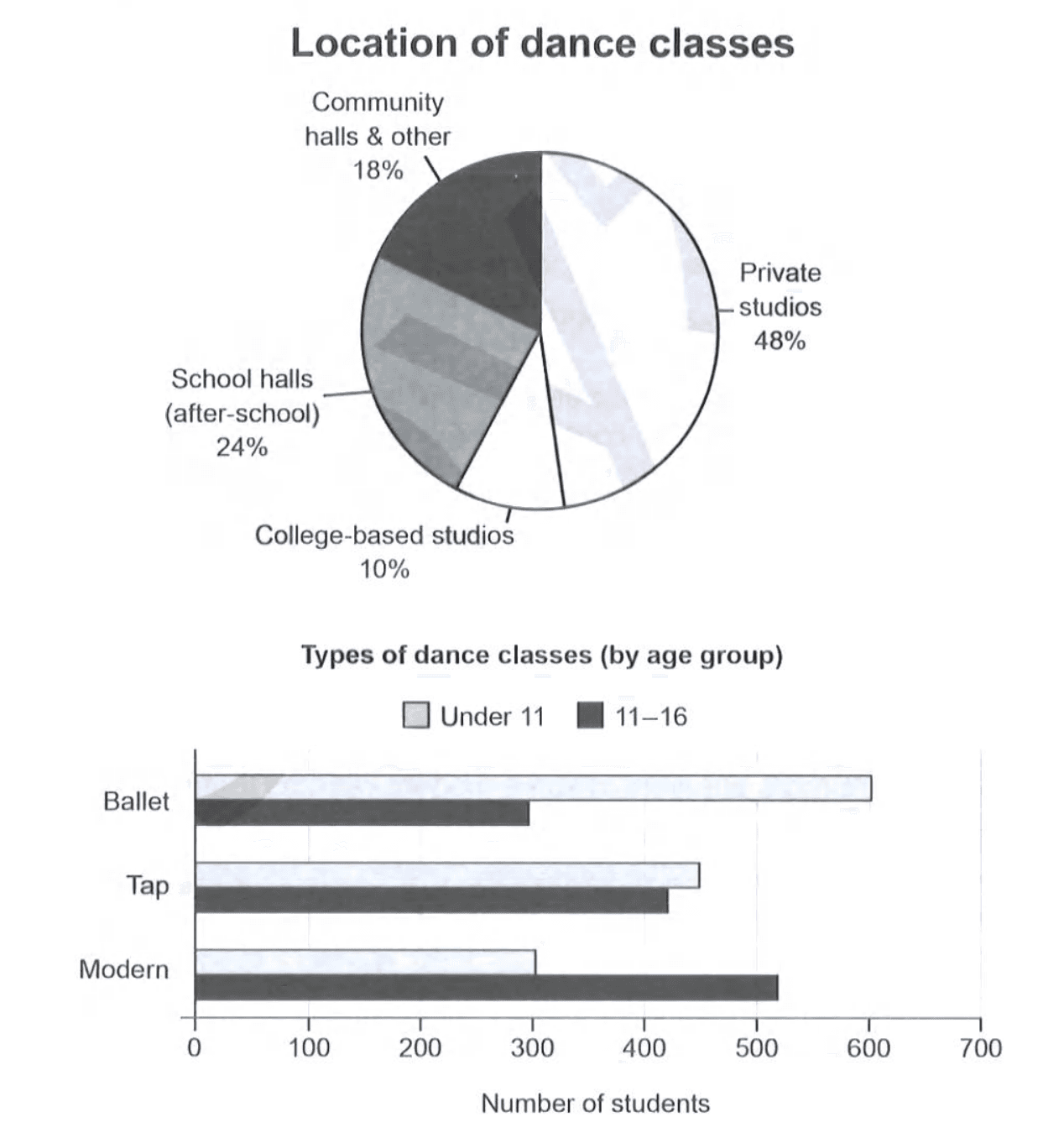
The pie chart shows the percentage of dance classes attended by young people in an Australian town at four types of location. The bar chart shows the number of students in ballet, tap and modern dance classes, divided into two age groups: under 11 and 11-16. Both charts describe the current situation.
The question
You should spend about 20 minutes on this task. The charts below give information on the location and types of dance classes young people in a town in Australia are currently attending. Summarise the information by selecting and reporting the main features, and make comparisons where relevant. Write at least 150 words.
Free and timed, with a live word count, just like the computer-delivered test. Then get an instant AI band score.
The exam simulator runs on a computer. Open this page on a laptop or desktop to practise.
Key features to report
- Private studios are by far the most common location, accounting for 48% of classes, almost half of the total and twice the share of the next location.
- School halls used after school make up 24%, community halls and other venues 18%, and college-based studios only 10%, the smallest share.
- Ballet is the most popular type among children under 11, with about 600 students, roughly twice the figure of about 300 for 11-16 year olds.
- Modern dance shows the opposite pattern: it is the most popular class for 11-16 year olds, with about 520 students, compared with only about 300 under-11s.
- Tap is the most balanced, with about 450 students under 11 and just over 420 aged 11-16, so the two age groups are almost equal.
- The bar chart shows a clear shift with age: younger children prefer ballet, while older children prefer modern dance.
Model overview
Overall, private studios are the most popular location for dance classes, accounting for almost half of the total. Ballet is the favourite among children under 11, whereas modern dance is the most popular with those aged 11 to 16, and tap attracts similar numbers from both age groups.
Paragraph plan
- 1
Introduction
Paraphrase the task: the pie chart shows where young people in an Australian town currently take dance lessons, and the bar chart shows how many students in two age groups attend ballet, tap and modern classes.
- 2
Overview
State the main point of each chart without figures: private studios dominate, ballet is most popular with younger children, modern dance with older ones, and tap is evenly split.
- 3
Body paragraph 1: locations
Give the pie chart figures in order: private studios 48%, school halls after school 24%, community halls and other 18%, college-based studios 10%. Compare private studios with the rest.
- 4
Body paragraph 2: types of class by age
Compare ballet (about 600 under 11 and about 300 aged 11-16), modern dance (about 300 and about 520) and tap (about 450 and just over 420).
Useful comparisons
- Compare private studios with all the other locations combined: 48% against 52%, so private studios take almost as many classes as the other three together.
- Note that school halls (24%) have exactly half the share of private studios, and college-based studios (10%) have the smallest share.
- Contrast ballet and modern dance as mirror images: ballet is twice as popular with under-11s, while modern dance is far more popular with 11-16 year olds.
- Present tap as the class with the most even age split, with only a small difference of about 30 students.
- Compare totals across age groups: roughly 1,350 under-11s against about 1,240 students aged 11-16, so younger children are slightly more numerous.
- Link the two charts only where the data allows; the charts do not show which classes take place at which location, so do not connect them.
Band 8+ model answer
192 words · An original model answer written for ieltswrites, not an official answer. It stays in English, as in the exam.
The pie chart shows where young people in an Australian town currently take dance classes, while the bar chart compares the number of students in two age groups who attend ballet, tap and modern dance lessons.
Overall, private studios are by far the most popular venue, accounting for almost half of all classes. In terms of style, ballet is the clear favourite among children under 11, whereas modern dance is the most popular choice for those aged 11 to 16, and tap attracts similar numbers from both groups.
Private studios host 48% of classes, exactly twice the proportion held in school halls after school hours, at 24%. Of the remainder, community halls and other venues account for 18%, while college-based studios are the least common location, with just 10%.
Turning to the types of class, around 600 under-11s attend ballet, roughly double the figure of about 300 for older pupils. The reverse is true for modern dance, which attracts about 520 students aged 11 to 16 but only about 300 younger children. Tap, meanwhile, is evenly split, with approximately 450 pupils under 11 and just over 420 in the older age bracket.
Why this answer scores highly
- Task Achievement
- The overview summarises both charts, and the body gives accurate figures for every location and every class type, with clear comparisons between the two age groups rather than a list of values.
- Coherence and Cohesion
- Each chart has its own paragraph, and the bar chart paragraph is organised around contrast, using by contrast, the reverse was true and meanwhile to link ballet, modern and tap logically.
- Lexical Resource
- The answer uses precise expressions such as account for, almost half, the remainder, evenly split and twice as many, and paraphrases dance classes and young people with lessons, pupils and age brackets.
- Grammatical Range and Accuracy
- The present tense is used consistently for current data, alongside comparative structures, relative clauses and fractions, all accurately.
Useful vocabulary
- account for
- make up a particular part or percentage of a total
- almost half
- a little less than 50%, a natural way to describe 48%
- the remainder
- the part that is left after the main part
- venue
- a place where an activity or event happens
- after-school
- happening when the school day has finished
- age bracket
- a group of people between two ages
- under-11s
- children younger than eleven
- twice as popular as
- attracting double the number of people
- the reverse is true
- the opposite pattern applies
- evenly split
- divided into roughly equal parts
- the least common
- the one used or chosen by the smallest number
- currently attending
- going to classes at the present time
Common mistakes
- Using past tenses throughout, when both charts describe the classes young people are currently attending.
- Treating the pie chart figures as numbers of students rather than percentages of classes.
- Inventing links between the charts, for example saying that ballet classes take place in private studios, which the data does not show.
- Misreading the bars, such as giving the 11-16 ballet figure as 350 or the modern dance figure for 11-16 year olds as 600.
- Describing only one age group in the bar chart, or listing all six bars without comparing the two age groups.
- Leaving out an overview that sums up both charts, which is required for a high Task Achievement score.
Frequently asked questions
- Which Cambridge book is this question from?
- These charts on the location and types of dance classes attended by young people in an Australian town are Writing Task 1 of Test 4 in Cambridge IELTS 19 Academic, published in 2023.
- Which tense should I use for these dance class charts?
- Use the present simple, because the question says the charts show classes young people are currently attending and no years are given.
- How should I organise an answer with two charts?
- Write one overview that covers both charts, then give each chart its own body paragraph. Do not connect the charts unless the data actually links them.
- How many words should I write for this Task 1?
- Write at least 150 words; about 170-200 words is enough to describe both charts and give an overview in about 20 minutes.
Free and timed, with a live word count, just like the computer-delivered test. Then get an instant AI band score.
The exam simulator runs on a computer. Open this page on a laptop or desktop to practise.